


Read our in-depth review and comparison of the top Customer Journey Analytics Software to boost customer retention. Choose the right tool to gain deep insights and elevate customer experience:
There was a time not long ago when tracking customer interactions across channels was a headache-inducing experience. It only became all the more challenging as new channels like SMS, email, and WhatsApp became popular.
Businesses had to use and subscribe to multiple different tools just so they could efficiently map a customer journey. This proved to be a tedious and costly endeavor.
Customer Journey Analytics Platforms: Top AI-Powered Tools
Thankfully, marketers and enterprises now have a treasure trove of customer journey analytics solutions to rely on.
These tools can not only streamline the process of tracking customer journeys, but some can even help you orchestrate and automate them.

[Via Commbox]
The customer journey analytics market today stands at a value of $3.1 billion. Analysts expect this value to balloon by up to $11.1 billion by 2035. If there ever was a good time to talk about customer journey analytics, it would obviously be now.
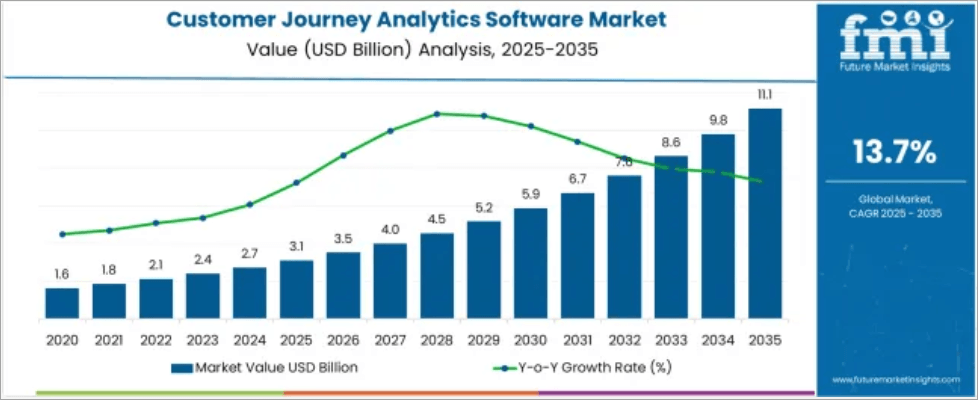
[Via Future Market Insights]
In this article, I would like to shed light on 10 such tools, which I and many like me believe to be some of the best customer journey analytics solutions you can find today.
So, without much further ado, let’s dive in.
What is Customer Journey Analytics Software
One could define customer journey analytics software as a platform that consolidates customer-related data from various online and offline channels. In the context of such software, these channels are often referred to as touchpoints, including email, SMS, support calls, and messenger/Chat apps.
Here is a video on what Customer Journey Analytics is:
By presenting this data to users, the platform essentially helps them visualize or analyze the end-to-end experience of a customer interacting with their product or service. These platforms are specifically designed to predict user intent, analyze their behavior, and identify pain points plaguing the experience.
This software will highlight where in a customer’s journey they hesitate or drop off. Marketers, product teams, and enterprises can then use these actionable insights to implement initiatives that improve the customer experience, thereby boosting conversions.
Who is Customer Journey Analytics Software For
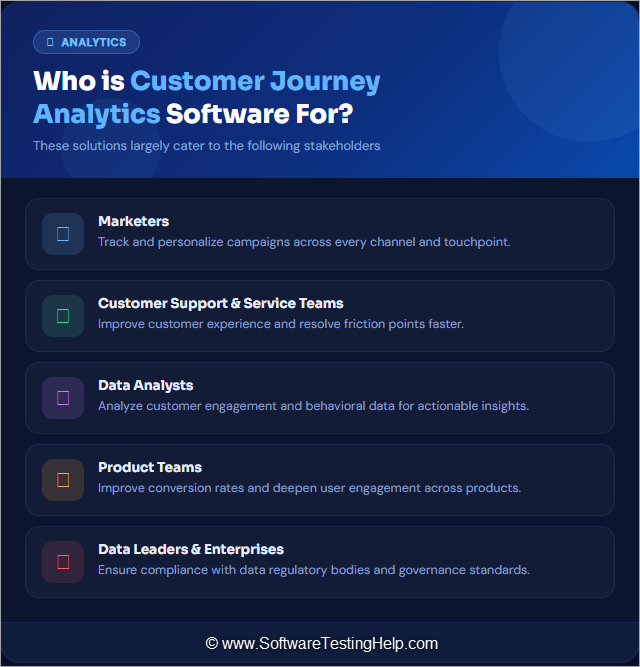
These solutions largely cater to the following stakeholders:
- Marketers who want to track and personalize their campaigns.
- Customer support and service teams that wish to improve the experience.
- Data analysts who wish to analyze customer engagement and behavioral data.
- Product teams who want to improve conversion and engagement.
- Data leaders and enterprises that wish to improve compliance with data regulatory bodies.
How to Choose the Right Tool for Customer Journey Analytics
The market today is flooded with customer journey analytics solutions, almost to the point of saturation. These tools aren’t exactly cheap. So, it would be in your best interest to choose the right tools to serve your goals.
Here’s how you do it:
- Define your Goal: What exactly do you wish to do with these solutions? Is your goal to improve end-to-end customer experience, predict customers’ intent, or analyze their behavior? Some clarity here will point you to the right tool.
- Omnichannel Mapping: You want your tool to map the customer journey across both online and offline channels. Go for a tool that clearly mentions omnichannel journey tracking as one of its key features.
- Real-Time Analytics: The platform should offer you actionable insights, predictive, and behavioral data in real-time. I would suggest opting for tools that not only offer you clear metrics but also let you build custom reports from them.
- User Interface: This should be a no-brainer. You want your tool to be easy to use and navigate. Go for tools with a customizable dashboard and comprehensive analytics.
- AI Features: A good, modern customer engagement and journey mapping tool will come equipped with generative or agentic AI capabilities. You stand to benefit immensely from a tool that has artificial intelligence offering insights and orchestrating journeys.
- Integration: You want your tool to integrate seamlessly with solutions in your existing tech stack. Make sure your tool supports strong integrations with various marketing, CRM, and analytics software.
- Privacy and Compliance: Customer journey analytics deal with sensitive data critical to the success of your organization. As such, look for tools that prioritize data privacy and compliance. Make sure they adhere to stringent security measures to protect customer data and exhibit compliance with regulatory frameworks like HIPAA, GDPR, etc.
Best Customer Journey Analytics Software
We have hand-picked the top Customer Journey Analytics tools and reviewed them for you:
- Insider One
- Cometly
- Reform
- Matomo
- Fullstory
- Quantum Metric
- TheyDo
- Braze
- Emarsys
- Adobe Customer Journey Analytics
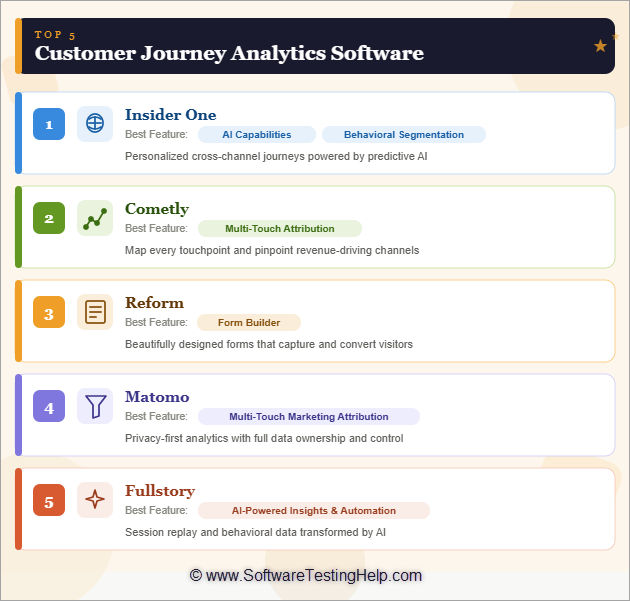
Comparing the Top Customer Journey Analytics Solutions
| Name | Best feature | Suitable for | Support | Rating |
|---|---|---|---|---|
| Insider One | AI Capabilities and Behavioral Segmentation. | E-commerce businesses, marketers, and analytics teams. | 24/7 live rep, Chat | 5/5 |
| Cometly | Multi-Touch Attribution | Content creators, product managers, data analysts, and marketers. | Live chat, email support, help center | 4.5/5 |
| Reform | Form builder | Marketers and lead generation specialists. | Email support, documentation, and help center. | 4.5/5 |
| Matomo | Multi-Touch marketing attribution | e-commerce sites, marketing managers, and data analysts. | Paid dedicated expert assistance, FAQ, User Guides, Knowledge Base | 4.5/5 |
| Fullstory | AI-powered insights and automation | Product teams and marketers | Community Forum, Dedicated paid support, Help Center, and User Guides. | 4.5/5 |
Detailed Reviews:
#1) Insider One
Best for AI Capabilities and Behavioral Segmentation.
Ideal for E-commerce businesses, marketers, and analytics teams.
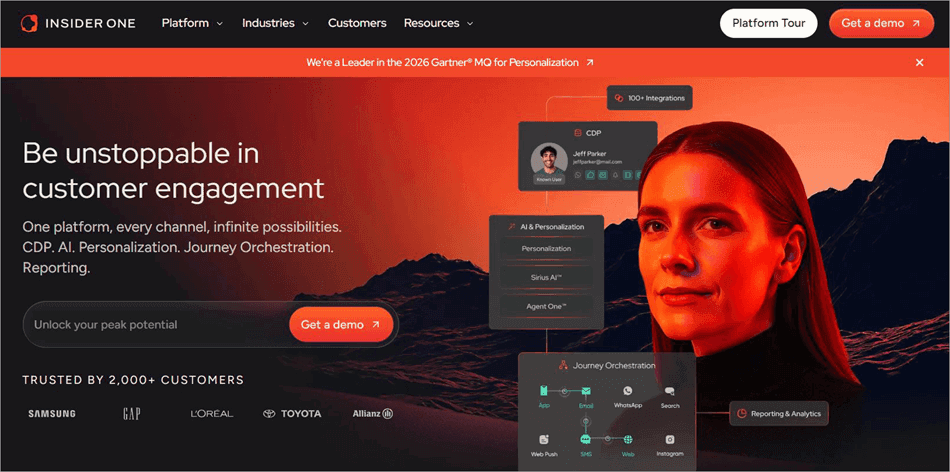
Insider One is the perfect tool to kick off this list. This AI-powered customer engagement platform features advanced analytics that’ll let you map out a customer’s journey across multiple channels and touchpoints. It offers all the tools necessary for you to track a customer’s journey with the utmost efficiency.
Where it absolutely shines is with behavioral segmentation. It basically lets you choose from over 120 customer traits and characteristics across three different audience types. The platform’s also powered by an AI, which gives it an edge over its contemporaries. You can count on its AI to predict user intent and understand customer behavior.
Insider One’s users also have only positive things to say about their experience with the software. Waldo’s, a long-time client, claims to have witnessed a 70% boost in their ROI with Insider One. Similarly, other clients have seen a 7x to 18x increase in their ROI after implementing Insider One.
Key Features:
- Reach customers across 12+ channels
- Real-time reporting and actionable insights
- Behavioral segmentation with 120+ traits and characteristics.
- Build customer journeys with 100+ ready-made templates
- Real-Time AI segmentation.
| Pros | Cons |
| Agentic, Generative, and Predictive AI | The initial set-up can be time-consuming. |
| Build detailed reports with granular metrics | |
| 100+ out-of-the-box integrations | |
| Multi-channel support |
Price: Insider One offers a subscription-based pricing model. Plans aren’t disclosed on the official website. You’ll have to contact the Insider One team for a quote. You can get a free demo upon request.
Website: https://insiderone.com/customer-journey/orchestration/
#2) Cometly
Best for Multi-touch attribution.
Ideal for Content creators, product managers, data analysts, and marketers.
Cometly is another platform that deserves a spot at the top of my list. The platform does a fine job of letting you map a customer’s interactions with every touchpoint they encounter. You are provided with actionable insights that shed light on how direct, paid, or organic traffic helped your business drive conversions.
You get a holistic view of all touch-points to map a customer’s journey, both before and after conversion. The platform stood out to me for its multi-touch attribution model. You can switch instantly between multiple attributions, like last touch, first touch, or U-Shaped, to learn precisely how each touchpoint contributed to conversion.
The AI-powered recommendations combined with real-time attribution data can help you boost your ROI significantly.
Key Features:
- Offers AI-powered insights
- Server-Side tracking
- Tracks all interactions across multiple channels.
- Fully customizable dashboards.
- Build tailored reports to analyze conversions.
| Pros | Cons |
| Robust integrations | Some users may find the tool expensive. |
| User-friendly interface | |
| No-code report builder | |
| AI capabilities |
Price: Contact Cometly for a quote. You can also book a free demo.
Website: https://www.cometly.com/
#3) Reform
Best for Form Builder for conversions.
Ideal for Marketers and lead generation specialists.
Reform is a bit different from the tools we have mentioned here. This is mainly a form builder that’s laser-focused on helping businesses boost their conversions. The platform features a form builder that’s finely tuned for conversions. It adheres to CRO best practices and has a design that can best be described as intuitive.
It helps you create forms that are easy for customers to use and navigate. Users can stop filling these forms midway and resume later at their convenience. You get data on how customers are interacting with your form in real-time. Plus, you can A/B test the data gathered to make informed decisions and create better forms.
Features:
- Qualification and Conditional Routing
- Lead Enrichment
- Spam Prevention
- Email Validation
- A/B Forms Testing
| Pros | Cons |
| Easy-to-use form builder | Lacks some advanced features that you’ll find in other tools on this list. |
| One-click integrations with CRM and automation tools. | |
| Real-time analytics | |
| Ready-made form templates |
Price:
Reform offers the following plans:
- Basic: $15/month, $150/year
- Pro: $35/month, $350/year
A forever-free plan with limited capabilities is also available.
Website: https://www.reform.app/
#4) Matomo
Best for Multi-touch marketing attribution.
Ideal for eCommerce sites, marketing managers, and data analysts.
Matomo does everything you need to precisely map a customer’s journey. The platform lets you map a customer’s path to their eventual goal, whether it is a purchase or downloads. Matomo performs a detailed analysis of a customer’s behavior to find out how customers interact with your product or service, where they hesitate, and where they drop out.
The platform also facilitates behavioral as well as engagement-based segmentation of your customers. Building reports is also easy with this platform. You get to choose from over 200 dimensions and metrics to build a detailed report with useful, actionable insights.
Features:
- Multiple Marketing attribution models are offered.
- Behavioral analytics and segmentation.
- Form Analytics to identify issues with forms.
- A/B Testing to improve sales and performance.
- Session recording to assess the first-hand experience of users on the website.
| Pros | Cons |
| Build custom reports | The tool gets expensive if you want to try the more advanced features. |
| Customizable dashboard | |
| Manage unlimited users | |
| User segmentation |
Price: Starts at $24/month for 50,000 hits/events.
Website: https://matomo.org/
#5) Fullstory
Best for AI-powered insights and automation.
Ideal for Product teams and marketers.
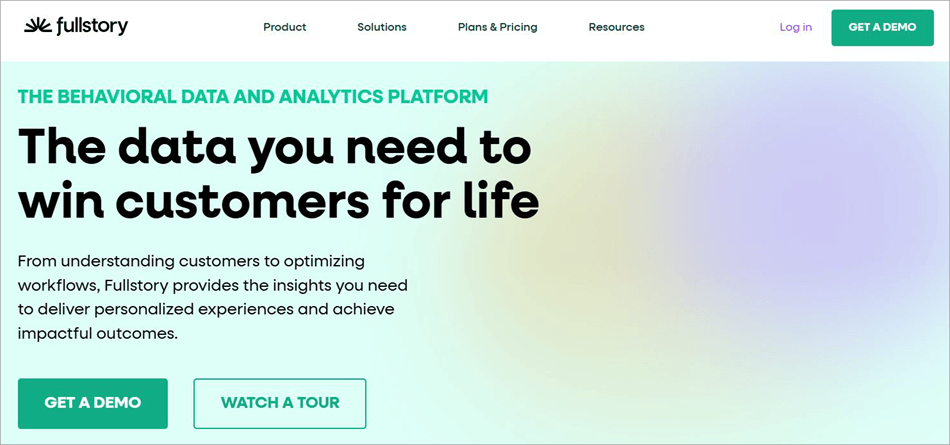
Fullstory lets you analyze behavioral data at scale, and that’s just one of the things that make this platform the best solution for customer journey analytics. The platform gets rid of the hassle that comes with manual tagging. Instead, it automatically maps a customer’s interactions across touchpoints.
Its AI is one of its strongest USPs. You can count on this AI to analyze the gathered behavioral data and transform it into information that’s easy to comprehend. You can later use these insights to connect with your customers at key moments in their journey.
Features:
- Automate and personalize content with AI
- AI and data-driven insights to boost conversions.
- Event-based analytics
- User segmentation
- Real-time data tracking.
| Pros | Cons |
| Automatically gather user interactions | Some users have reported minor performance issues. |
| Intuitive AI-driven insights | |
| Strong security features | |
| User-friendly |
Price: Fullstory offers flexible subscription plans along with premium add-ons. You’ll need to contact the team for a clear quote. A demo is also offered.
Website: https://www.fullstory.com/?fs_product=AN
#6) Quantum Metric
Best for AI-powered user journey summarization.
Ideal for Product managers, marketers, the UX design team, and large enterprises.
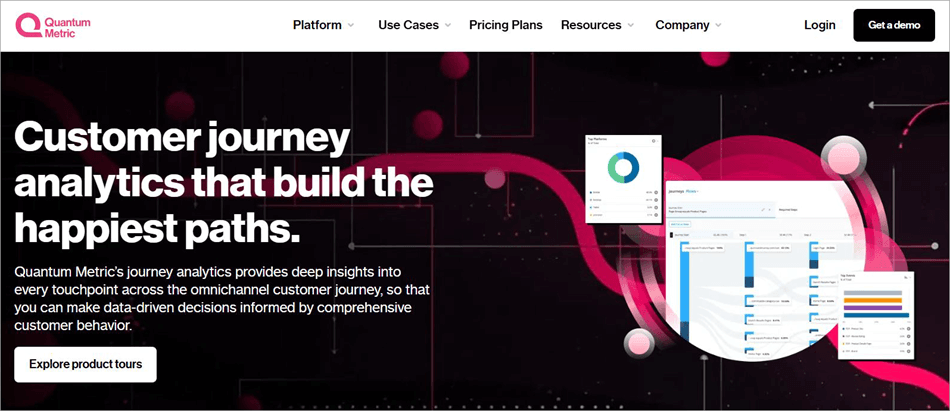
Similar to the best software on this platform, Quantum Metric also does not disappoint when it comes to mapping customer journeys across channels. What distinguishes this platform from its contemporaries is the generative AI, Felix, powering it.
This AI will take complex, long-duration session replays and summarize them. The AI also aggregates analytics for each customer who has had a similar experience with a product or service.
Key Features:
- Understand individual customer behavior with session replays.
- Autonomous AI agents to analyze each aspect of the customer journey.
- Offers considerably enhanced data insights
- User analytics to monitor behavior, adoption, and retention.
- Nested segment building
| Pros | Cons |
| Real-time data capture | Customer support isn’t as responsive as I would’ve hoped. |
| Pre-built custom dashboards | |
| Powered by Felix AI | |
| Best in class security and privacy features |
Price: Quantum Metric offers flexible subscription plans, which are revealed upon contact with the sales team. You can also request a free demo.
Website: https://www.quantummetric.com/digital-analytics/customer-journey-analytics
#7) TheyDo
Best for AI-powered journey management.
Ideal for Customer experience teams, product managers, marketers, and large enterprises.
The first thing I was immediately enamored by when using TheyDo was its neat interface. Thanks to this user-friendliness and intuitive workflows, it is very simple to map customer journeys through this platform. The platform does a good job of unifying all types of data, qualitative and quantitative, for a more structured approach to customer journey mapping.
Hands-down, the best aspect of this platform is its AI. The AI helps you uncover new insights as well as enrich existing data. It carefully assesses a journey’s structure and suggests improvements to make it easier to understand. It can analyze both qualitative and quantitative data to accurately detect pain points that can affect customer experience.
Key Features:
- Automate workflows to map customer journeys.
- Align performance metrics with insights.
- Explore details with flexible filters.
- Mine, map, and manage data with AI.
| Pros | Cons |
| AI-Driven Insights | The platform can be expensive for some users. |
| Intuitive interface and dashboard | |
| Integrates with 30+ connectors. | |
| Good security features |
Price: You’ll need to contact TheyDo’s team for a custom quote. A 30-day free trial and a free demo of the tool are also offered.
Website: https://www.theydo.com/
#8) Braze
Best for No-code customer journey orchestration.
Ideal for Startups that are focused on growth and marketing teams.
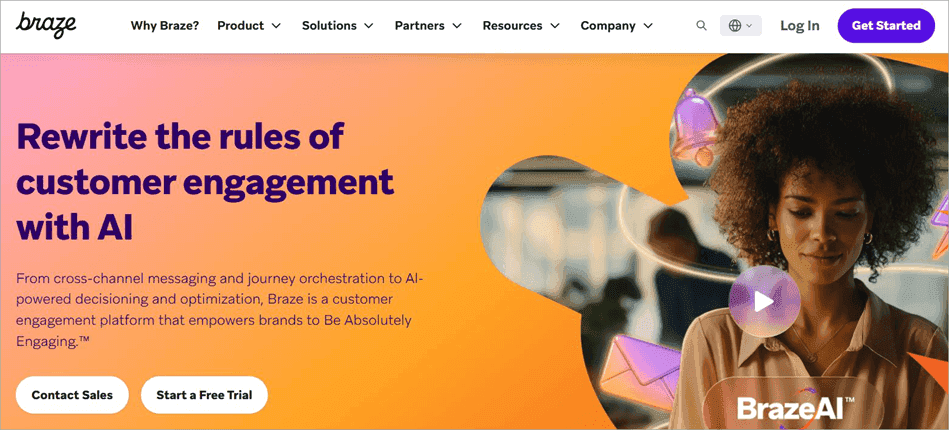
From an intuitive AI to a robust analytics dashboard, Braze is yet another software on this platform that offers you everything to map customer journeys with ease. You can use it to design and launch dynamic user journeys.
This platform grants you deeper context into customer journeys, helping you uncover insights that can help improve customer experience. The platform also facilitates seamless collaboration, allowing teams to visualize, customize, and share data without hassle.
Key Features:
- Automate and personalize customer journey data with AI.
- Orchestrate cross-channel journeys without coding.
- Build and customize customer engagement dashboards.
- Campaign and Canvas reporting.
- 100+ out-of-the-box filters to build audience segments.
| Pros | Cons |
| Drive engagement with AI | UI may seem outdated |
| Auto-scaling infrastructure | Customer service is limited in regions outside the USA. |
| Ensures enterprise-level privacy and security compliance | |
| 140+ turnkey integrations |
Price: You’ll need to contact Braze’s sales team for a quote. A free demo is offered upon request.
Website: https://www.braze.com/
#9) Emarsys
Best for AI-driven customer engagement
Ideal for Medium to large enterprises.
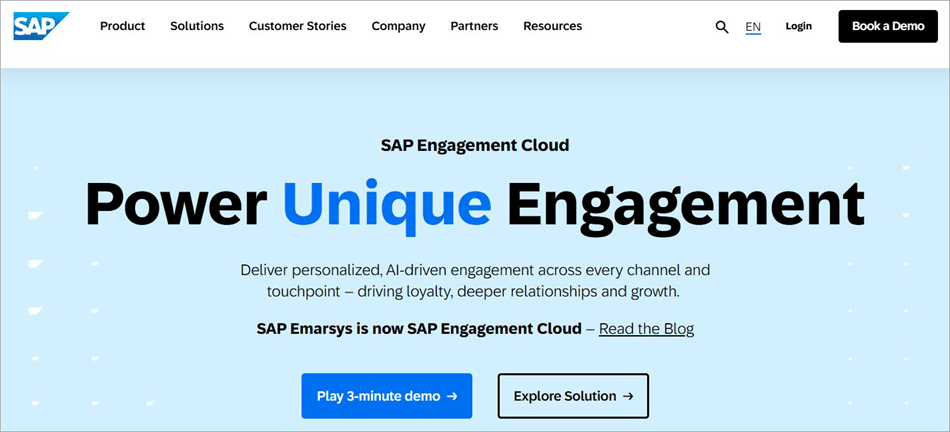
Emarsys has the advantage of being associated with the widely popular SAP. Businesses can count on this platform for AI-driven engagement across channels and touchpoints. Emarsys excels at personalizing every interaction you have with customers by consolidating data from multiple sources and activating it across channels within your business.
You get AI-driven insights, which prove useful in enriching customer data and segments. These insights can also help you predict customer behavior, measure outcomes, and thus maximize across channels.
Key Features:
- AI-Powered Analytics and Reporting.
- Predict and personalize customer journeys with AI.
- Omnichannel Marketing
- Customer data enrichment and segmentation.
| Pros | Cons |
| Excellent automation | The interface needs improvement |
| Personalizes customer interactions | A steep learning curve is involved |
| Ready-to-deploy, fully customizable journeys | |
| Supports integrations with various third-party solutions. |
Price: Contact the sales team for a custom quote. A demo is offered upon request.
Website: https://emarsys.com/
#10) Adobe Customer Journey Analytics
Best for End-to-end customer journey analysis.
Ideal for Marketing leaders, product teams, analytics teams, data leaders, and CIOs.
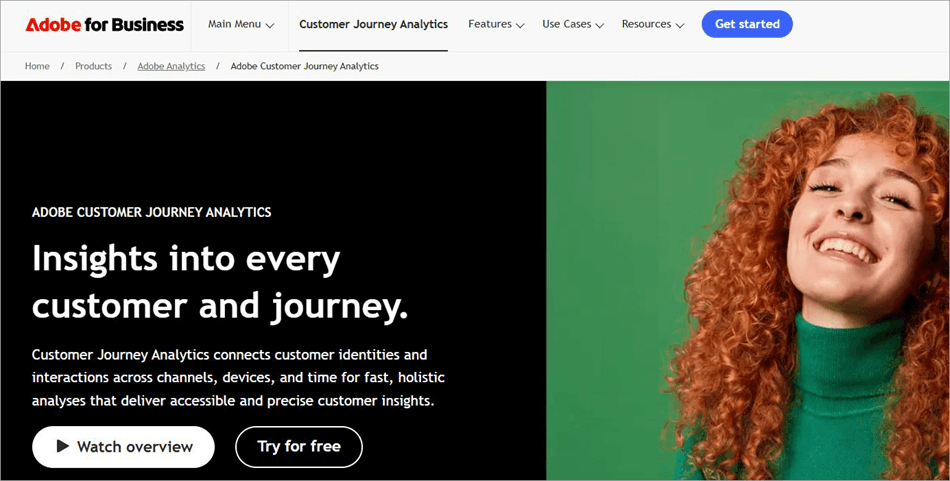
Adobe offers you an advanced AI and ML-powered tool that can link customer identity and interactions across channels and devices. The platform can help you track each step of a customer journey sequentially. With visualizations and an intuitive interface, the platform can unearth insights that would’ve otherwise been elusive.
You can count on the platform AI and ML to analyze each custom interaction and outcome. Another thing that stands out about this tool is its ability to detect anomalies. Its AI can automatically detect anomalies across data and alert you through in-app notifications.
Key Features:
- Query data with natural language processing.
- AI-driven insights and anomaly detection.
- Automated data onboarding and management.
- Drag-and-drop interface to perform complex data analysis.
| Pros | Cons |
| Built-in privacy controls and data governance | Implementation can be complicated |
| AI and ML-powered | Expensive |
| Retroactive data transformation |
Price: You can try the platform for free in a limited capacity. For a quote, you’ll need to contact Adobe’s sales team.
Website: https://business.adobe.com/products/adobe-analytics/customer-journey-analytics.html
Steps to Get Started with Customer Journey Analytics
Choosing the right tool is just half the battle won. You’ll still need to be diligent when implementing your chosen customer journey analytics tool. The suggestions below will ensure implementation is seamless.
#1) Maintaining Data Quality: You want journey maps that are both simple and accurate. That’s only possible if you audit the data before launch. Ensure onboarding is effective by working hand-in-hand with your collaborators when setting up data pipelines.
#2) Team Training: Make sure your team is provided with hands-on training and understands the value of the project they are working on.
#3) Test and Improve: Set clear, measurable goals for success from the get-go. Do not lose sight of these goals and use analytical tools to track them consistently. Change or adapt as your needs evolve.
How We Evaluated These Customer Journey Analytics Tools
My research into these tools began by frequenting major tech publications like G2 and Capterra. Software with generally or universally rave reviews was the first to catch my attention. I then pitted these tools against each other on various critical parameters.
My priority was to pick user-friendly tools that offered solid integrations and supported omnichannel customer journey tracking. Tools with AI and ML capabilities were immediately shortlisted.
Finally, I made sure to include tools that can cater to their core customer base, which entails marketers, data analysts, and product teams.
Real-World User Cases of the Above Tools By Industry/Scenario
| Tool | Use Case |
| Insider One | • Financial Services • Retail and E-commerce • Beauty and Cosmetics • Automotive • Travel and Hospitality • Telecommunications |
| Cometly | • Health and Wellness • Marketing Agencies • Travel • Financial Services |
| Reform | • Lead generation and enrichment |
| Matomo | • Marketing Attribution • Tracking Personal Data • Log Analytics • Consent-Free tracking |
| Fullstory | • Gaming • Travel and Tourism • Insurance • Food and beverage • Retail and E-commerce |
| Quantum Metric | • Analytics • AI Detection • Gaming • Healthcare • Telco |
| TheyDo | • Journey Mapping • Framework Standardization • Impact tracking. |
| Braze | • Engagement nurturing • Onboarding Optimization • Acquisition Improvement |
| Emarsys | • Retail • Sports and entertainment • Consumer products • Travel and hospitality |
| Adobe Customer Journey Analytics | • Audience segmentation • Journey mapping • Churn prediction. |
Where is Customer Journey Headed
With the advent of ML and AI technology, I think it is quite clear where the customer journey is headed in the near future. As of 2026, organizations are already moving away from mapping the traditional linear path to purchase.
They seem to have understood that the future lies amidst AI-driven ecosystems, with journey mapping being more personalized and non-linear in nature. We already have tools like Insider One offering AI-driven recommendations to boost ROI.
Companies will now seek to prioritize immediate gratification and digital-first interactions. The days of one-time, static journey mapping are almost over. Instead, we should be ready for journey maps that rely heavily on continuous mapping with an emphasis on emotions.
Frequently Asked Questions
1. What is Customer Journey Analytics?
Customer Journey Analytics entails a process utilized to track customer interactions with a product or service across multiple channels and devices. It is done to visualize the entire customer path that ultimately leads to purchase.
2. What is the best CX software?
experience as they interact with an enterprise’s product or business. In my opinion, the best CX software today is as follows:
• Insider One
• Cometly
• Reform
• Matomo
• Fullstory
You’ll find a more detailed review for each of these tools above.
3. What are the 5 pillars of the customer journey?
Customer Journey entails the following 5 pillars:
• Awareness
• Consideration
• Decision
• Retention
• Advocacy
You’ll need to deliver material across each of these pillars to make a customer feel valued enough to make a purchase.
4. What benefits does Customer Journey Analytics offer?
The following are some benefits you can expect from a proper customer journey analytics:
• Mapping the customer journey across multiple online and offline channels.
• Help you understand customer habits and identify pain points.
• Facilitate personalized engagement
• Facilitate customer segmentation
• Help build customer loyalty
• Help with customer retention
5. What is the difference between Customer Journey Analytics and customer journey mapping?
Customer journey analytics is a data-driven, quantitative approach to tracking a customer’s experience. Customer journey mapping is a qualitative, visual representation of that same experience.
7. What is the difference between Customer Journey Analytics and CDP?
Although CDP and customer journey analytics may seem to serve the same purpose, they are two very different concepts. CDP or Customer Data Project basically entails collecting fragmented data to create one, persistent customer profile.
On the other hand, customer journey analytics entails tracking interactions with customers across different touchpoints. I’ve already showcased examples for CJA above. A retail business using data from offline store visits, with data for online browsing to create a unified customer view, is a good example of CDP.
8. Is Google Analytics a Customer Journey tool?
As Google Analytics helps you track user or customer interactions across the web and applications, I would say that it is indeed a good, free-to-use customer journey tool, especially for start-ups.
9. What are the stages of a customer journey?
By stages, you probably mean the phases a customer goes through while interacting with a brand. Those phases are as follows:
• Awareness: The customer becomes aware of the brand
• Consideration: The customer starts researching your brand
• Purchase: The final decision to buy is made.
• Retention: Entails post-purchase engagement with the brand.
• Advocacy: A satisfied customer will recommend the brand to others.
Conclusion
Improving customer experience is essential to ensuring you win their loyalty. Tracking a customer’s experience manually can be challenging and riddled with errors. This is where a customer journey analytics solution comes to your rescue.
These tools consolidate data on a customer’s journey across both online and offline channels. As such, you have an idea of what in their journey is making them hesitate or where they are dropping off.
You can then use these analytics to tailor messaging and content in accordance with your customers’ preferences, thus eliminating any friction.
All of the above tools are exceptional at their function. If I had to recommend one among them, I would suggest you start with Insider One. The platform’s AI capabilities and powerful segmentation features make it one of the best customer journey analytics solutions you can invest in right now.
Research Process: The total time involved to complete and publish this article is approximately 43 hours. This content was created through a structured research approach to ensure accuracy and reliability.
For more-related guides, you can explore our range of tutorials below:
- Best Customer Data Platform (CDP) Companies
- Customer Experience Management Software
- Best Customer Feedback Software (COMPARED)
- BEST Client Management Software (RANKINGS)
- Top 10+ Best Customer Onboarding Software Tools
- Top 10+ BEST Client Management Software (RANKINGS)
Was this helpful?
Recommended Reading
-

We had a look at the 8 Brilliant Tips To Handle a Difficult Coworker in Workplace in our previous tutorial. This Tutorial Describes Real-Life Scenarios with a Dissatisfied Customer or an Incompetent Supplier and Teaches You Strategies to Deal with Them Successfully: All the customers may not get satisfied alike…
-

Read the reviews to compare the best Customer Feedback Software platforms to collect online feedback from customers and improve the brand’s performance: Customer Feedback Software refers to a platform that helps in collecting customer feedback, finding gaps, and improving the customer experience. It comes with a variety of features like…
-
Comparison of top Customer Data Platforms with features, pros, cons, client details, etc. to identify the best CDP software as per your requirements: CDP stands for Customer Data Platform. It refers to the software that provides its users with the features like collecting and classifying customers' data, 360° view of…
-
List of the Top Online Customer Experience Management Software and Tools: What is Customer Experience (CX) Management? Customer experience management is the process that is used for designing and replying to customer’s feedback. This process will help you meet customer expectations and thereby improve customer satisfaction. Customer Experience software is…


