


Here we will review and compare the top Cryptocurrencies to Invest in to help you select the best Cryptocurrency that offers the highest rate of return and high liquidity:
Cryptocurrencies allow people to send and receive money to and from anyone around the world regardless of their location at a very cheap rate compared to fiat alternatives. A second use case is investing in them where you can buy and speculate prices as happens in forex, or you can store the cryptocurrencies and sell later at a profit.
Table of Contents:
Top Cryptocurrency

Cryptocurrencies are easy to invest in, operate, and manage because one can do so using a crypto wallet on their computer or mobile phone. Besides, there is a low entry requirement, and individuals do not need to have any documents or identification to open the accounts required to store, send, and receive cryptocurrencies.
This tutorial discusses the best cryptocurrencies to invest in. Bitcoin – the oldest cryptocurrency, Litecoin, ChainLink, and Ethereum have the highest market capitalization and daily transaction volume. This means you can benefit from investing coins in this top cryptocurrency list without suffering a lack of liquidity.
Frequently Asked Questions
Q #1) How do I start to invest in cryptocurrencies?
Answer: The first thing is to conduct detailed research about investing in cryptocurrencies, the different and best ways of investing in crypto, different investment platforms, and of course the scams out there. You will arrive at the best investment option as per your goals and objectives.
Q #2) Which are the best ways to invest in cryptocurrencies?
Answer: You can invest by speculating crypto prices where you buy given crypto, for instance, top 10 cryptocurrencies, and sell later at a profit. In this case, you can own a portfolio of different cryptocurrencies that give the highest return.
One of the best ways of investing in cryptocurrency is buying during initial coin offerings when prices are lowest and selling at profits later on. The other method is dedicated crypto trading where you can use crypto trading technologies, analytics, and bots or invest with professional traders.
You can also buy shares in index funds for different cryptocurrencies, choose to invest in exchange-traded funds, crypto mining, staking, buy security shares in a blockchain or crypto company, start a crypto startup, and invest in crypto options and put-ins.
Q #3) How much do I need to invest in cryptocurrencies?
Answer: There is no minimum capital requirement when investing in cryptocurrencies because all you need to do is to buy units of the cryptocurrencies you want to invest in, and you can speculate on prices and sell at a profit. You can start with as low as $10. The amount to invest depends on your risk averseness and availability of the capital.
Q #4) How much should I invest in cryptocurrencies?
Answer: It is recommended to invest only 5% to 30% of your investment capital in top cryptocurrency when starting. A 5% investment minimizes your risk of investment. You can increase that percentage when you are familiar with how they work and what affects investment and are certain that you can earn more profits.
Also Read =>> Understanding Bitcoin and Cryptocurrencies
Market Trends:
- There are over 4,000 cryptocurrencies right now, which is a very sharp increase in the number compared to only about 66 in 2013. The top twenty cryptocurrencies make up nearly 90% of the total market capitalization. Most of these are launched through the initial coin offering method, which works as an initial public offering. About 4% of people invest in cryptocurrencies in the United States according to the image below.
- Stockpiling the top cryptocurrencies in anticipation of the price going up, buying and trading of blockchain stocks, participating and buying tokens through crowdfunding anticipating the price will go up later, and angel funding startups are the top four methods you can use to invest in cryptocurrencies.
- Besides investing through the above methods, you can also invest in crypto mutual funds, Exchange Traded Funds, stocks, crypto share funds, options, and other investment products with different companies. Other methods include mining and staking where you put a given amount of funds into a project by buying tokens and assisting to verify transactions.
The below image shows how crypto investment compares to other types of investments in America:

[image source]
Expert Advice:
- If buying stock, funds, shares, and options, choose the investment which has the highest rate of return or projected rate of return. If buying top 10 cryptocurrencies, use analytics methods and professional trading tools and bots to project future prices and market movements before buying and selling.
- Security stocks in top cryptocurrencies present the best investment opportunities for those investing in crypto because they are secured by law. If investing through a third party, ensure they are trusted, have operated for years, are verifiable, and are known in the space.
Terms Apply: Please read all the details and terms carefully on the below Crypto platforms before investing. Cryptoassets are highly volatile. Your capital is at risk. Don’t invest unless you’re prepared to lose all the money you invest. This is a high-risk investment, and you should not expect to be protected if something goes wrong.
List of the Best Cryptocurrency to Invest in
Here is the list of top cryptocurrencies:
- Bitcoin (BTC)
- Litecoin (LTC)
- ChainLink (LINK)
- Ethereum (ETH)
- Uniswap (UNI)
- Polkadot (DOT)
- Tether (USDT)
- Stellar (XLM)
- Cardano (ADA)
- Dogecoin (DOGE)
- Tron (TRX)
Comparing the Top Cryptocurrencies
| Cryptocurrency | Market Capitalization | Transaction fees (sending and receiving) | Rating |
|---|---|---|---|
| Bitcoin (BTC) | $3.6 Trillion | $22.24 per transaction | 5/5 |
| Litecoin (LTC) | 12.328 billion | $0.20 per transaction | 4/5 |
| ChainLink (LINK) | $0.2 trillion | $22.24 per transaction | 4/5 |
| Ethereum (ETH) | $0.2 trillion | $15.83 per transaction | 3.8/5 |
| Uniswap (UNI) | $15.9 billion | $2–3 per transaction | 3.8/5 |
| Polkadot (DOT) | $33 billion | 3% fee per trade. | 3.7/5 |
Recommended Reading =>> Best Cryptocurrency Exchange service
Let us understand the above-mentioned cryptocurrencies in detail below.
Recommended Crypto Exchange
eToro – Best Crypto Exchange
Best for social and copy trading.

eToro is not a cryptocurrency, but it lets you invest in 20+ cryptos including Bitcoin, Bitcoin Cash, Ethereum, XRP, Litecoin, and Stellar. You can trade and invest in each of these, as well as send and hold them as wished. They can also be converted to fiat assets and withdrawn and or reinvested in traditional fiat assets and stocks.
Features:
- Copy-trading strategies from over 20 million users, including crypto investors.
- Invest in over 20+ cryptos.
- 100k virtual portfolio when you sign up.
- “Limited time offer: Deposit $100 and get a $10 bonus”
Disclaimer – “Cryptocurrency is offered by eToro USA LLC (“the MSB”) (NMLS: 1769299) and is not FDIC or SIPC insured. Investing involves risk. Don’t invest unless you’re prepared to lose all the money you invest. This is a high-risk investment, and you should not expect to be protected if something goes wrong. Take 2 mins to learn more here.“
#1) Bitcoin (BTC)
Best for predictable investors, group, and company investors.

Bitcoin was the first digital peer-to-peer cryptocurrency developed in 2009 and is now applicable to the masses, where any person can use it to store value, send value to, and receive value on blockchain from anyone from anywhere in the world without requiring any central authority such as a bank or central government as happens with fiat transactions.
Features:
- It is peer-to-peer meaning one transacts it directly with peers without any middlemen. It is the most popular in the top cryptocurrency list.
- It is based on a distributed network called the Bitcoin blockchain.
- Nodes who have installed the software on their computers verify payments digitally through a process called consensus.
- Blockchain information is encrypted using the cryptography encrypting technique.
- A user initiates payments digitally by creating a public and private key and then sends the cryptocurrency to the recipient’s wallet address.
- Time taken to verify payments, which are contained in one single verified block, is 10 minutes.
- Miners are paid a verification fee.
- Each miner gets 6.25 new BTC to verify a block and add it to the chain.
- Miner earnings have halved from 50 BTC since the creation of the BTC to the current 6.25 BTC.
- Transaction Fees: Sending fees: 22.24 USD per transaction but can go very low
- Daily Trading Volume: $57 billion.
- Market Capitalization: $3.6 trillion
Rating: 5/5
Website: http://www.bitcoin.org/en
#2) Litecoin (LTC)
Best for miners and individual investors.

Litecoin cryptocurrency is based on Litecoin blockchain which employs Scrypt proof of work algorithm. It was developed from Bitcoin, which uses SHA-24 proof of work algorithm. Like Bitcoin, it can therefore be mined but requires ASIC and GPU miners rather than CPU miners.
Litecoin allows users to send and receive cross-border transactions without censorship. It produces four times as many blocks as Bitcoin or a new block every 2.5 minutes compared to Bitcoin’s production of 1 block in 10 minutes.
Features:
- Peer-to-peer cryptocurrency and open-source software project
- Production limit is 84 million
- Time for producing a block and verifying a transaction is 2.5 minutes.
- Can be mined with CPUs but the high competition requires ASICs and GPUs.
- Can be bought and sold on open markets and exchanges.
- Supports usage on many crypto wallets.
- Transaction cost on the network: $0.20 per transaction.
- Daily Transaction Volume: $5.51 billion.
- Market Capitalization: 12.328 billion
Rating: 4/5
Website: http://www.litecoin.org
#3) ChainLink (LINK)
Best for corporate investors and organizations.
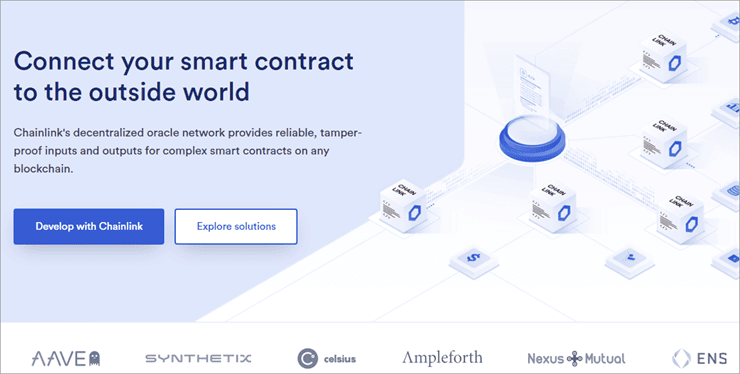
The potential of the ChainLink blockchain network, whose cryptocurrency is known as Link, is in its ability to link blockchain and other non-blockchain data and platforms. This means blockchains can source and use smart contracts, and data from any source such as traditional banks, central banks, NGOs, individuals, and companies and other blockchains and IoT sources.
Blockchain-based smart contracts will use oracles to pull data through off-chain data pools APIs and other tech. Those contributing data to these data pools and APIs and another tech can be rewarded for providing the data while those who use this data through the smart contracts can pay for it.
Features:
- Uses smart contracts which allow users to enter into digital contracts that have monetary value and are executed automatically and in a trustless manner.
- Users on the blockchain including blockchains can request off-chain or non-blockchain data and pay in form of Link cryptocurrency.
- Uses ERC-20 standard and the ERC-677 standard.
- Transaction cost: Sending and receiving fees: 22.24 USD per transaction but can go up or down at any time.
- Daily Trading Volume: $23.6 B
- Market Capitalization: $0.2 trillion
Rating: 4/5
Website: https://chain.link/
#4) Ethereum (ETH)
Best for smart contracts, individual, group, and company investors.
Ethereum became the second cryptocurrency after Bitcoin and allowed the use of automated digital smart contracts – coded contractual agreements – in real-world business scenarios as well as the ability for people and companies to build decentralized applications (dApp) on the blockchain network.
One of the greatest successes of Ethereum is smart contracts. These smart contracts work like accounts on the Ethereum blockchain and can send transactions but they are not manually controlled by the user. Instead, they work and run automatically when the rules defined by the contract accounts are met.
Features:
- Decentralized applications that use smart contracts allow any business and individual to customize and deploy their contracts on blockchain whether it is data exchange contracts, financial value exchange contracts, etc.
- Cryptocurrency sending and receiving is verified almost automatically.
- Ethereum block size is below 100 KB.
- The Ethereum Virtual Machine constitutes software and architecture that understands smart contracts and allows users to interact with them.
- Allows users to create Decentralized Autonomous Organizations (DAOs) which are for democratic decision-making.
- Trading fees: $15.83
- Daily Trading Volume: $23.6 B
- Market Capitalization: $0.2 trillion
Rating: 3.8/5
Website: https://ethereum.org/en/what-is-ethereum/)
#5) Uniswap (UNI)
Best for crypto exchange platforms and liquidity providers.

Uniswap is the crypto token that powers the Uniswap exchange, which allows users to swap ERC-standard-based token. UNI is a decentralized finance token with which users of the platform can pay fees and holders can participate in voting matters to be developed or launched on the mainnet or voting of other governance matters.
The token, which is used for platform governance and liquidity mining, was launched in September last year and the total number will be distributed over the course of 4 years. Members of the exchange can stake LP tokens to earn UNI tokens.
Features:
- It lets users easily swap crypto between Ethereum and ERC-compliant tokens and cryptocurrencies.
- The pool feature allows users to provide liquidity to other users of the exchange.
- Liquidity providers earn commission from the fees collected when other users of the exchange use the exchange.
- It is peer-to-peer meaning it is sent directly from one user to another without any middlemen or banks.
- Besides having other wallets to store, send, and receive, you can also use MetaMask, Coinbase, or Fortmatic wallets.
- Transaction fees: $2–3 per transaction.
- Daily Trading Volume: $497 million
- Market Capitalization: $15.9 billion
Rating: 3.8/5
Website: https://uniswap.org/
#6) Polkadot (DOT)
Best for Decentralized Finance and Web Technologies.
Polkadot is a decentralized finance token that emanates from one of one of Ethereum’s co-founders, Dr. Gavin Wood and whose initial coin offering raised over 145 million USD in Ethereum and is a project by the Switzerland-based Web3 Foundation.
Features:
- It is based on a blockchain whose goal is to decentralize the web through Web 3.0 and interoperate all blockchains.
- Those who check transactions on the network must possess DOT crypto to be nominated as a validator.
- It uses a protocol that is a version of the Proof of Stake (PoS) called GHOST-based Recursive Ancestor Deriving Prefix Agreement (or GRANDPA for short). Nominated Proof of Stake.
- Transaction cost: Not clear.
- Daily Trading Volume: $89 billion
- Market Capitalization: $33 billion
Rating: 3.7/5
Website: https://polkadot.network/
#7) Tether (USDT)
Best for predictable value investments.
Tether token is a stable token – meaning its value of 1 token does not intend to change and is pegged to the USD. In other words, 1 tether token is valued at 1 USD with a very slight change below and above the value. The token was previously known as Real Coin but changed its name in November 2014.
Features:
- Suitable for holding value in cryptocurrencies or digital assets against the high volatility of cryptocurrencies.
- It is based on the Omni protocol, which interfaces with all blockchains.
- Transaction fees: 0.1% per trade of above $1000.
- Daily Trading Volume: $89.5 billion
- Market Capitalization: $38.9 billion
Rating: 3.6/5
Website: https://tether.to/
#8) Stellar (XLM)
Best for corporate investments in supply chains and logistics.
Stellar token seeks to ease the transfer of funds to and from new markets to make it easy for the users to access these markets. The value of these funds are represented in the platform’s native token Lumens (XLM) to facilitate the transfer of this value by creating a digital representation of the real money on the platform.
Features:
- Anyone in any country can transfer or receive Stellar tokens to and from anyone else in any country such that they do an exchange of value.
- Lumens are also used to pay transaction fees in the Lumen platform.
- The blockchain uses a protocol called stellar Consensus Protocol (SCP).
- The issue amount is 50 billion Lumens in existence.
- Transaction cost: 0.000041 US Dollar
- Daily Trading Volume: $89.4 million
- Market Capitalization: $9.1 billion
Rating: 3.6/5
Website: https://www.stellar.org/?locale=en
#9) Cardano (ADA)
Best for making smart contracts and dApps.

Cardano project started with the Ethereum co-founder Charles Hoskinson. As a native token for the Cadano platform, the ADA token is used to send and receive digital funds anywhere in the country without middlemen. ADA was named after a 19th-century mathematician thought to be the first computer programmer, Ada Lovelace.
Suggested reading =>> Top platforms to buy Cardano Crypto
Features:
- The ADA tokens can be mined by users.
- Works as a smart contract platform.
- The token is also used by platform users to pay for premium services on the platform.
- The limit to be minted is 45 million ADA tokens.
- The protocol of the network is called the Ouroboros proof-of-stake algorithm.
- Trading fees: 0.180738 US Dollar
- Daily Trading Volume: $10.4 billion
- Market Capitalization: $45.5 billion
Rating: 3.6/5
Website: https://cardano.org/
#10) Dogecoin (DOGE)
Best for mining.

Dogecoin has its roots in the Shiba Inu dog meme and was created by created in December 2013 by Jackson Palmer as a joke. The purpose was to use it as a tipping coin on Reddit, YouTube, and other platforms. It also served as a way people would poke at Bitcoin and the emerging tokens that used to appear at the time but immediately disappear in thin air. It also focused on being a token more accessible, usable, and user-friendly than Bitcoin.
Also read =>> How to mine Dogecoin
Features:
- The crypto is a fork of Lyckycoin, which forked from Litecoin, with a shorter block time than Litecoin.
- The use of the Scrypt algorithm means the crypto can be mined with CPU.
- The total supply to be minted will be 113,516.569.069 DOGE.
- Transaction fees: $0.15 per transaction.
- Daily Trading Volume: $.09 billion
- Market Capitalization: $7.4 billion
Must Read => Dogecoin Price Prediction
Rating: 3.5/5
Website: https://dogecoin.com/
#11) Tron (TRX)
Best for entertainment and gaming applications.
Tron cryptocurrency was founded in September 2017 by Tron Foundation based in Singapore. It works like a decentralized media and entertainment platform. The ERC20 standard token is used in the TRON platform after porting from the Ethereum blockchain where it started. The platform has three tokens namely Tronix, Tron Power, and Tron 20 token.
Features:
- The TRX is the main net token for the Tron Protocol and now uses TRC10 technical standards being compatible with the ERC-20 tokens.
- TRC-20 based tokens on the same platform that are used for smart contracts and implemented with the Tron Virtual Machine.
- TRX is used to send and receive transactions on the Tron platform and to pay for fees.
- Transaction fees: 15 transfers free of charge.
- Daily Trading Volume: $1.4 billion
- Market Capitalization: $3.8 billion
Rating: 3.4/5
Website: https://tron.network/
Conclusion
This tutorial offers a list of the top cryptocurrencies you can start investing in with little risk because they offer the highest rate of return and highest liquidity as they are popular among users.
Also read =>> How to start mining Ethereum
Investors can start to buy owning a portfolio in the top cryptocurrency and changing it to suit profit and investment needs. Otherwise, other best methods of investing in crypto are exchange-traded funds, security tokens, initial coin offerings, trading, buying blockchain and crypto shares, index funds, and options.
Further reading =>> Top Penny Crypto stocks to invest in for great returns
Before starting, be sure to do your own detailed research about investment in crypto, the best third parties you can invest and trade with, the best platforms for trading and investing in crypto, and crypto scams.
Was this helpful?
Recommended Reading
-

This Comprehensive Tutorial explains What is Cryptocurrency, the Technology behind it, how is it Created & how does it work, along with Bitcoin Cryptocurrency: Cryptocurrencies are popular today especially with the success of Bitcoin as it is the first public cryptocurrency. They are important investment vehicles for many blockchain companies…
-
Here we compare features of the top apps for crypto exchanges to help you get the best cryptocurrency exchange service as per your need: Cryptocurrency trading can be done in two ways i.e. either to exchange one digital currency for another you want to use or keep, or to make…
-
Here we will explore Crypto Mining Software and compare some of the best or even free Bitcoin Mining Software available in the market: Well, you have your Bitcoin mining hardware and other Bitcoin essentials in place. All you need now is a free Bitcoin miner software that can help you…
-
This Tutorial Explains Various Blockchain Applications, Use Cases & Examples. It also Includes Steps for Integrating Blockchain in Organizational Settings: This previous introductory Blockchain Tutorial covered the basics of blockchain technology. Now, we will go beyond the basics by looking at how the technology is being utilized today in the…
-
This Comprehensive Blockchain Tutorial Explains What is Blockchain Technology, its History, Versions, Types, Building Blocks and how does a Block Chain Work: Blockchain has emerged as a popular technology among the top organizations. There are high expectations from this technology and adoption rates are increasing with up to 77% of…
-
This Tutorial Explains What is a Blockchain Explorer, why use them and how do Blockchain Explorers work, their History and some Common Blockchain Explorers: In the previous Blockchain Wallet tutorial of Blockchain tutorial series, we learned about blockchain wallet types & how do they work & how to generate them.…
-
List of the Top BlockChain Companies with Detailed Comparison: Are you interested in blockchain technology? Are you looking for the best of its companies? You may be a developer or a technology officer who desires to work in a good blockchain company. There can be any reason to know more…
-
This Tutorial discusses the Basics of Blockchain Security. Also explains how Cryptography, Digital Signatures, Hashings, and Private and Public Keys work to Secure Data: In the previous Blockchain ETF tutorial of the Blockchain tutorial series, we have learned about the workings of Blockchain ETF along with their comparison with other…


