


Review and compare the best Crypto Wallets with features to find the best Bitcoin Wallet for sending and receiving Bitcoins:
Crypto wallets allow you to generate unique addresses with which you receive crypto. They also allow users to send crypto to other wallet addresses over the blockchain and on a peer-to-peer basis. A wallet address is secured through a private key, which allows a user to recover it in case it is lost.
The best Bitcoin wallets allow users to watch their real-time crypto balances for their portfolios. This can be done on mobile phones, PCs, over the web, and other devices. Some Bitcoin wallets can sync on multiple devices.
Table of Contents:
- Bitcoin Wallets
- List of the Top Bitcoin Wallets
- Comparison of the Best Crypto Wallets
- #1) Tangem
- #2) Bitamp
- #3) Uphold
- #4) Zengo
- #5) eToro
- #6) NAGA
- #7) Crypto.com
- #8) Cypherock X1
- #9) BitBox02
- #10) CoinStats
- #11) Exodus
- #12) Mycelium
- #13) Trezor
- #14) Electrum
- #15) Wasabi Wallet
- #16) Opolo
- #17) Cobo
- #18) Ledger
- #19) BitPay
- #20) Atomic Wallet
- #21) BitcoinWallet
- #22) Bitcoin Core
- #23) Green Address
- #24) Bitstamp
- #25) OKX
- Frequently Asked Questions
- Conclusion
Bitcoin Wallets

Most crypto wallets use the BIP32 key derivation standard which enables wallets to generate new wallet addresses for incoming transactions and keep change in a separate wallet, thus improving the privacy of transactions.
Some wallets also use P2SH or Pay-to-Script-Hash addresses that allow users to create new addresses to receive Bitcoins and to unlock the balances by following the set rules of using private keys. They are commonly used in multi-signature wallets, and the addresses will have multiple digital signatures and private keys that prove ownership of the funds.
The most common type of wallet addresses are known as Pay-to-PubKey Hash (P2PKH) addresses were to unlock the funds, the recipient must use the private key associated with the public key has used to create the address.
Hierarchical Deterministic (HD) wallets use a master key and individual sets of private keys for each of the wallet addresses in the wallet. The secret 12-word phrase acts as a master key to recover the entire wallet.
Pro-Tips:
- The most secure crypto wallets are the hardware wallet that allows signing of crypto transactions offline. These best crypto wallets can be used for storing a large number of cryptocurrencies.
- Wallets with trading and exchange features are best for crypto traders as they allow them to buy and sell crypto without third parties.
- Multi-asset wallets are some of the best Bitcoin wallets as they allow the storage of more than one type of digital asset.
- Groups, for instance, can choose the multi-signature wallets that allow multiple parties to own private keys separately and more than one party will have to authorize a transaction with their private keys before it is allowed.
Fact Check:
- Did you know that only about eight percent of crypto holders keep their coins safe? The rest is unsafe because of the many non-private, non-secure, and vulnerable wallets out there.
- $1.9 billion worth of crypto was lost to hackers alone in 2020, down from $4.5B in 2019.

[image source]
List of the Top Bitcoin Wallets
Here is a list of popular and best online Bitcoin wallets:
- Tangem
- Bitamp
- Uphold
- Zengo
- eToro
- NAGA
- Crypto.com
- Cypherock X1
- BitBox02
- CoinStats
- Exodus
- Mycelium
- Trezor
- Electrum
- Wasabi Wallet
- Opolo
- Cobo
- Ledger
- BitPay
- Atomic Wallet
- BitcoinWallet
- Bitcoin Core
- Green Address
- Bitstamp
- OKX
Comparison of the Best Crypto Wallets
| Tool Name | Best For | Platform | Our Ratings |
|---|---|---|---|
| Tangem | Ultimate security, all in one, wallet. | Mobile (Android and iOS) |  |
| Bitamp | Users who value privacy, control over their private keys, and a straightforward, no-frills Bitcoin wallet experience. | |
|
| Zengo | Ultimate security, all in one, wallet. | Mobile (Android and iOS) | |
| NAGA | Auto copy trading | iOS and Android | |
| Crypto.com | Crypto-to-fiat conversions via Visa card (all cryptos) | Android, iOS, desktop, and web. | |
| Cypherock X1 | No seed phrase backup | — | |
| BitBox02 | Institutions and custodians, groups, exchanges, etc. | — | |
| CoinStats | Mobile app for iOS and Android | iOS and Android |  |
| Exodus | Beginners and diversified multicrypto holders | Desktop, iOS and Android | |
| Mycelium | Crypto traders and diversified hodlers | Web wallet | |
| Trezor | Crypto institutions, exchanges, groups, organizations, and custodians | Hardware wallet compatible with software wallets |  |
| Electrum | Traders and investors experienced with crypto | Desktop | |
| Wasabi Wallet | Transparent-conscious users and groups | Desktop | |
Review of cryptocurrency wallets:
#1) Tangem
Best for Ultimate security, all in one, wallet.

Tangem Wallet is a non-custodial Bitcoin wallet that offers unparalleled security and convenience. Its simple credit card form factor allows users to conveniently manage their Bitcoins offline, protecting them from hacking and other online threats.
One of the standout features of Tangem Wallet is its simplicity. The wallet is incredibly simple to set up and use, with a user-friendly app that makes it easy to swap, send, receive, buy, and sell Bitcoin. The wallet uses NFC protocol, allowing users to use the mobile app with a simple tap of their card. Additionally, the Tangem Wallet is fully IP68-protected and comes with a 25-year warranty.
Another key advantage of Tangem Wallet is its high level of security. The wallet is built with top-notch chip security and is protected from invasive and non-invasive attacks. This Bitcoin wallet also comes with a seedless backup option.
With its unique combination of security, convenience, and reliability, Tangem Wallet is the perfect solution for anyone looking to store and manage their Bitcoins with confidence.
Features:
- Buy Bitcoin and other cryptocurrencies using bank transfers, credit/debit cards, or Apple Pay with Mercuryo.
- Swap Bitcoin and cryptocurrencies between different blockchains securely in Tangem Express without needing to move assets to exchanges.
- Stake crypto to earn passive income. Tangem’s native staking feature is coming to Solana, Cosmos, Polkadot, Polygon, Cardano, Avalanche, Tron, Binance Smart Chain, NEAR, Tezos, Cronos, and Kava. You can also connect NFT, DeFi, and other dApps to Tangem Wallet via WalletConnect.
Cons:
- No native NFT support.
- No multi-sig signing.
Type of Wallet: Hardware.
Incorporated Exchange: Yes
Compatible with Software Wallets: No
Price: $54.90
#2) Bitamp
Best for Users who value privacy, control over their private keys, and a straightforward, no-frills Bitcoin wallet experience.
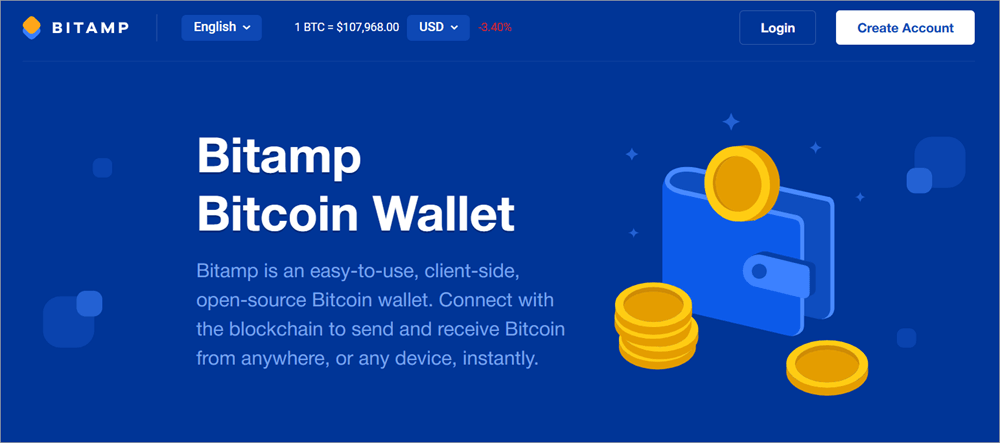
Bitamp is a free, open-source Bitcoin wallet that runs entirely in your web browser. It allows users to send and receive Bitcoin securely without creating an account or sharing personal information, making it a simple and private option for managing your BTC.
Designed as a non-custodial wallet, Bitamp ensures that your private keys and seed phrase remain on your device, giving you full control over your funds. All wallet operations, including key generation and transaction signing, happen locally in the browser.
The wallet is compatible with seed phrases from other wallets such as Ledger, Trezor, Electrum, Mycelium, and Blockchain. This allows users to consolidate or migrate their Bitcoin holdings without losing control of their funds.
With its minimalist interface and open-source code, Bitamp is ideal for users who want a straightforward, secure, and privacy-focused Bitcoin wallet without extra features or unnecessary complexity.
Features:
- Non-Custodial: You retain full control over your Bitcoin with no third-party involvement.
- Open-Source: The wallet’s code is publicly available for review and verification.
- Browser-Based: Access your wallet from any device with a web browser.
- No Registration Required: No email or personal information needed to use the wallet.
- Secure: Your seed phrase and private keys are never transmitted or stored; they remain on your device.
- Compatibility: Supports importing seed phrases from other wallets like Ledger, Trezor, Electrum, Mycelium, and Blockchain.
Cons:
- Limited to Bitcoin: Does not support other cryptocurrencies.
- No Mobile App: Only accessible via a web browser; lacks dedicated mobil e applications.
Type of Wallet: Software wallet
Incorporated Exchange: No
Compatible Hardware Wallet: Yes (via seed phrase import)
Price: Free
#3) Uphold
Best for Converting BTC to equities, metals, and fiat.
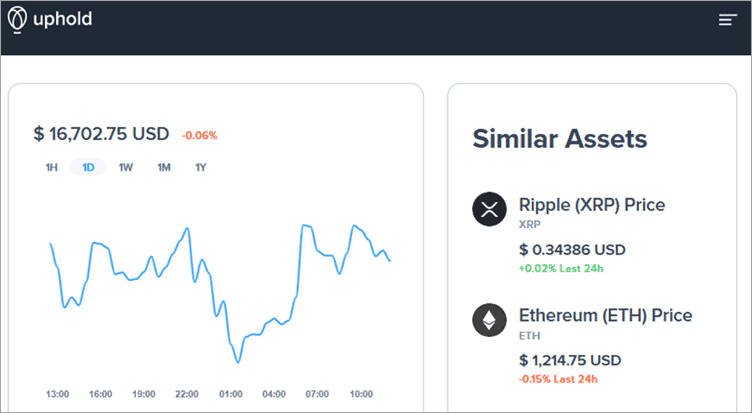
Uphold BTC wallet has the advantage of easier conversion of assets from stocks to BTC. In other words, you can convert your stock assets held at Uphold to BTC at zero commission.
With a BTC wallet at Uphold, you can also spend your holdings directly (without using third-party crypto-fiat conversion tools) and easily on ATMs and merchant stores using the Uphold Card. The card pays crypto or fiat cash back rewards to those spending crypto to purchase goods and services.
Besides, the wallet allows you to seamlessly, quickly, and easily trade between Bitcoin and other assets including precious metals, fiat currencies, other cryptos, and stocks. The wallet also supports ordinary sending, receiving, and holding Bitcoin.
Features:
- Buy and sell Bitcoin instantly using credit/debit cards, Google Pay, Apple Pay, etc. Bank transactions are also supported.
- 0% trading commission. Pay spreads as low as 0.9-1.2% when trading BTC and ETH cryptos on Uphold. 1.05% for business accounts.
- $0.99 transaction fee when trading between assets and the amount is under $100. This applies when the transactions are done using the Uphold Debit Card or when the transactions are automated.
- Deposit fees vary from one crypto to another. BTC is $0.
- Staking crypto – earn APYs as high as 25% when staking some tokens. 15% commission charged on rewards.
- Free when funding the wallet from a bank account.
Cons:
- Custodial BTC wallet.
Type of Wallet: Software – web and mobile wallet, API.
Incorporated Exchange: Yes
Compatible with Hardware Wallets: Yes
Price: $0
#4) Zengo
Best for ultimate security, all in one, wallet.
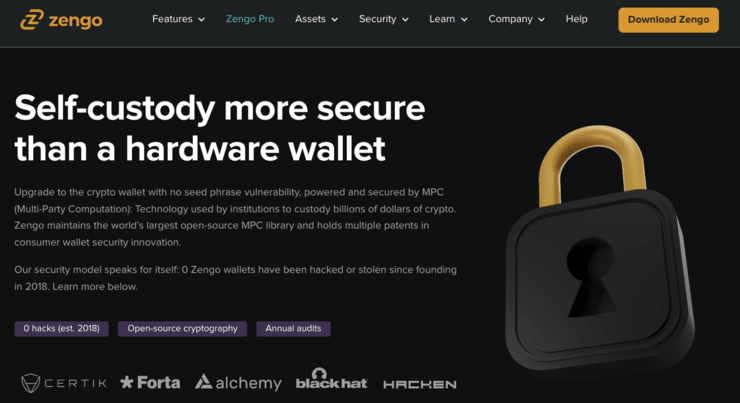
Zengo is one of the best Bitcoin wallets given its features. First, it allows you to buy Bitcoin using a credit card, debit card, bank wire, Apple Pay, Google Pay, and other cryptos. Second, it is a non-custodial wallet that lets you save cryptocurrency without complicated private key management exercises.
With Zengo, all you need to do is enter your email and verify it.
The private key is split into two multiple parts — one part is stored in your device and the other on Zengo’s server.
To recover your wallet you will need to set up the 3D FaceLock verification and save your recovery file on iCloud/Google Drive/ DropBox. This recovery file is NOT a private or a secret share and is useless to a hacker.
Features:
- Buy Bitcoin and other cryptos through bank transfers, credit cards, debit cards, Google Pay, Apple Pay, and other cryptos. Minimum trade is as low as $30, depending on the payment method.
- Swap Bitcoin for other cryptocurrencies (and vice versa) across multiple blockchains. This means you do not have to own multiple cryptocurrency wallets across different blockchains to do so.
- Swap Bitcoin for other cryptocurrencies (and vice versa) for as little as a 0.5% processing fee. Other fees such as network fees.
- Invest crypto to earn passive income – you can stake Tezos and other cryptos directly on Zengo or connect third-party staking and lending Dapps to Zengo via WalletConnect bridge. You earn 8% or more in APY. You can also connect NFT, DeFi, and other dApps to Zengo depending on what you want to do with them.
- The wallet is non-custodial and does not require you to keep managing private keys to restore. The recovery is super easy if the wallet is deleted or the phone is lost.
Zengo Pro: While Zengo Essentials continues to be offered for free, upgrading to Zengo Pro unlocks a suite of premium security features for as low as $16.67 a month.
- Legacy Transfer: Grant a beneficiary access to your digital assets in case of death or prolonged absence with a feature inspired by traditional inheritance systems. This is the market’s first and only self-custodial tool supporting this functionality.
- Asset Withdrawal Protection: Prevent unauthorized withdrawals with 3D FaceLock biometric verification.
- Advanced Web3 Firewall: Real-time risk assessments and alerts that protect you against Web3 attacks.
- Priority 24/7 Support: typically response time of under 3 minutes, supporting 180 languages.
Cons:
- Only available on mobile.
Type of Wallet: Software Wallet
Incorporated Exchange: Yes
Compatible with Hardware Wallet: No
Price: Free
#5) eToro
Best for diversified crypto and social investing.

eToro hosts a Bitcoin wallet that lets you keep, track, and manage your Bitcoin holdings.
This is in addition to buying and selling Bitcoin for fiat through banks and credit cards. For those who like other cryptos, eToro offers wallets for storing, tracking, managing, and sending Bitcoin Cash, Ethereum, Litecoin, XRP, Stellar, and TRON.
Features:
- Use advanced orders and charting to improve your investing.
- Copy-trading strategies for over 20+ crypto assets
- Portfolio monitoring and crypto charting.
- Integrate with a hardware wallet for offline storage of BTC, ETH, XRP, LTC, BCH, XLM, and TRX.
- Manage your private keys in addition to using extra security features like 2FA.
Cons of the tool: Fewer cryptos are supported compared to many other crypto trading platforms.
Type of Wallet: Software
Incorporated Exchange: Yes
Compatible Hardware Wallet: Yes
Price: Wallet is free to use.
Terms Apply. Copy Trading does not amount to investment advice. The value of your investments may go up or down. Your capital is at risk. Past Performance is not an indication of future results.
#6) NAGA
Best for automated copy trading.

NAGA is the best and most innovative copy trading as it allows traders to auto copy trades or trading strategies of other users with little effort. Simply visit leaderboards, sort traders as per profit generated in a given period and auto-copy.
However, NAGA features inbuilt crypto wallets for holding 50+ cryptocurrencies including Bitcoin, Ethereum, Bitcoin Cash, etc. These wallets support depositing, receiving, sending, and withdrawing cryptocurrencies.
For those using in-built NAGA Bitcoin and other wallets, you can not only track your portfolio but also stake cryptos on the NAGAX exchange. NAGAX exchange also supports swapping cryptos, as well as manual or smart trading with advanced order types. NAGAX wallets also support creating, collecting, and trading NFTs.
Features:
- Wallet offers decentralized and risk-free storage.
- Mobile agnostic wallet.
- Wallet connects to other exchanges.
- Wallet allows investing through staking 10+ assets.
- Bitcoin wallets can be funded directly from fiat payment gateways – credit card, wire, Skrill, Neteller, and Giropay, EPS, Ideal, p24, in addition to Bitcoin Cash, Bitcoin, Litecoin, Dash, Ethereum, and Naga coin.
- NAGA card to spend crypto from the wallets. Buy goods and services from ATM stores and withdraw from ATMs.
- Reduce trading fees with NAGA cards or NAGA coins.
- Demo trading account that can be upgraded to a live account.
- Minimum investment: $250.
- Leverage trades by up to 1000 times.
Type of wallet: Software web and mobile wallet.
Incorporated exchange: Yes
Compatible hardware wallet: Yes
Trading fees: NAGA — Spreads of just 0.1 pips. $5 withdrawal fees. The 3-month-inactivity fee is $20. Rollover, swap fees, and other fees may apply. NAGAX — Deposit crypto is free. Maker and taker fees from 0.4% (for 0-1,000 NGC coins in balance) to 0.005% (for 10,000+ NGC coins). The crypto withdrawal fee depends on the crypto in question.
#7) Crypto.com
Best for staking users. High-interest rates.

Crypto.com provides hosted wallets for 250+ cryptocurrencies and tokens, including Bitcoin. One of the reasons for having a wallet on the exchange is to swap crypto or trade it for fiat.
For this reason, Crypto.com offers an aggressive option to let you spend crypto in your wallet through a Crypto.com Visa card. You can pay for goods and services or withdraw fiat from visa-supported merchant stores globally, including ATMs. Different Visa cards offer different CRO staking percentage earnings.
Since wallets offer additional trading features like margin trading and loaning, they also suit active crypto day traders. Nevertheless, you can also rely on the platform’s extra security features and USA FDI insurance to hold crypto on the hosted Bitcoin wallets.
Features:
- In-house tokens called CRO are spent on paying gas fees.
- Pay and get paid for goods and services with crypto through the platform.
- Track portfolios from within the wallets.
- Stake holdings in the wallet and earn up to 14.5 p.a. on the holdings.
- Fiat withdrawal via fiat at a limit of $2,500/day limit (2 transfers/day) and $50,000 per month with a 30 transfer cap.
Cons of the tool:
- Limited support
Type of Wallet: Software wallet
Incorporated Exchange: Yes
Compatible Hardware Wallet: Yes. Connect to Ledger Hardware Wallets and Ledger Live application.
#8) Cypherock X1
Best for No seed phrase backup.
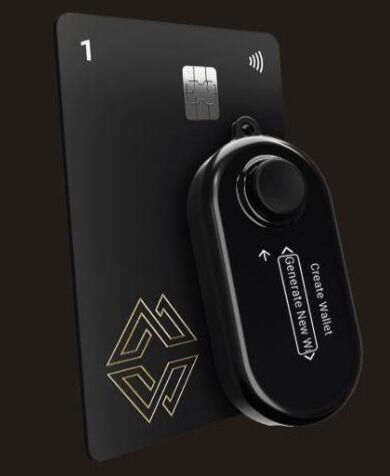
Cypherock X1 makes it to our list as it is one of the first wallets that does not require seed phrase backup, thus making it highly secure. Another aspect that makes this wallet appealing is its ability to distribute private keys into 5 cryptographic parts. Each of these parts is stored in a separate tamper-proof hardware. You only need any 2 of the 5 parts to make a transaction.
This makes Cypherock X1 efficient in protecting funds against loss and theft. Cypherock X1 also facilitates trustless recovery and timely wallet updates without compromising the software or hardware’s overall security. The hardware you get is sturdy while the software is robust, thus making the task of sending and receiving crypto-assets very simple.
Features:
- Over 3000 assets supported
- No seed phrase backup
- Open Source
- EAL6+ Secure Element
- Decentralized Private Key Storage
Cons:
- Limited software compatibility
Type of Wallets: Hardware powered by an open-source software.
Incorporated Exchange: —
Compatible with Hardware Wallets: —
#9) BitBox02
Best for institutions and custodians, groups, exchanges, etc.

BitBox hardware wallet lets users store their crypto private keys offline. It comes with an app – Android and desktop BitBoxApp that allows users to manage coins in their portfolio. The app has in-app guide on crypto and how to use the hardware. It features an OLED display and touch buttons that allow users to physically and manually sign transactions, including offline signing.
Features:
- Supports more than 1500 crypto and tokens including Bitcoin and Ethereum.
- There is also the option of a Bitcoin-only hardware wallet for storing BTC only.
- USB-C compatible hence can be used with any mobile device.
- 24 recovery words to recover wallet in case of loss or damage.
- Universal second-factor authentication allows users to use the device for securing their online accounts such as crypto exchanges and online email.
Cons of the tool:
- No integrated exchange.
Type of Wallet: Hardware
Incorporated in Exchange: No
Compatible Hardware Wallet: Yes
Price: $28 for BitBox 02, 59.00 Eur for BitBox 1.
#10) CoinStats
Best for Mobile app for iOS and Android.
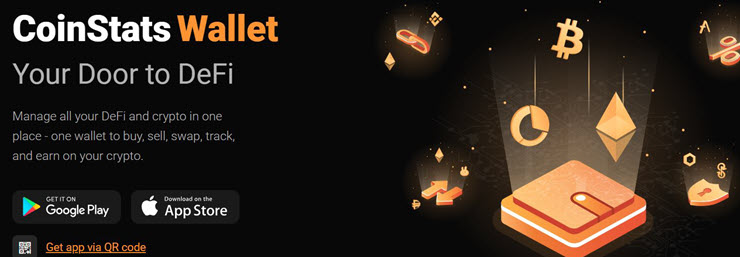
CoinStats offers you a simple-to-use and intuitive app that can transform your iOS and Android device into a wallet. This wallet will let you connect to all your DeFi and Crypto portfolios. You will be able to manage, buy, sell, swap, and trade across multiple exchanges from a single place. The wallet is exceptionally secure.
You will have complete control over your DeFi and Crypto portfolios. You’ll be able to export your private keys securely via this app. The wallet seamlessly syncs with any bank card, thus allowing you to easily buy any coin using fiat. You can also earn handsome interest on your deposits in the wallet.
You’ll have the opportunity to earn up to 20% Annual Percentage Yield on the crypto assets you hold in the CoinStats wallet.
Features:
- Track all crypto and DeFi assets across exchanges at any time and from anywhere.
- Available for iOS and Android.
- Supports the trading of over 20000+ cryptocurrencies.
- Track and manage over 1000 DeFi protocols.
- Easily set custom crypto alerts.
- Syncs with any bank card for hassle-free crypto purchases.
Cons:
- Some users have reported issues with syncing.
Type of Wallet: App
Incorporated Exchange: Yes
Compatible with Hardware Wallets: Yes
Price: Available with CoinStats Premium and Degen plans, which cost $13.99/month and $62.21/month respectively.
#11) Exodus
Best for diversified multi-crypto holders.

Exodus is one of the best online Bitcoin wallets as it allows users to get live price charts for cryptos. Live or real-time charts allow users to monitor market movements even on their mobile devices and hence can make decisions to sell or buy to add to their portfolio before it is too late.
Features:
- Supports over 100 cryptocurrencies.
- Works on Desktop, Mobile, and syncs with crypto hardware wallets including Exodus and Trezor devices. It works on iOS and Android mobile devices.
- Allows one to buy and sell all supported cryptocurrencies from the app without having to withdraw or use a centralized exchange.
Cons of the tool:
- Not open-source hence hard to verify the code.
- No customs fees for Ethereum and other altcoins.
Type of Wallet: Software wallet. HD wallet.
Incorporated Exchange: Yes
Compatible Hardware Wallet: Yes
Price: Free
Recommended Reading => List of BEST Crypto Wallet UK
#12) Mycelium
Best for crypto traders and diversified holders.

Like Exodus, Mycelium provides direct and one-on-one control of your crypto private keys and they will never leave your device. You can also lock the wallet with a secure pin. It allows users to operate multiple accounts and reuse addresses.
Features:
- Facilitates in-app exchange and trading for ERC-20 and BTC cryptocurrencies. This is done using the Local Trader feature. It is one of the best multi-cryptocurrency wallets.
- In-app educational materials to help you understand crypto usage and security.
- It supports paper wallets, private keys, and master seeds.
- It integrates with any secure cold storage such as web wallets, Trezor, Ledger, KeepKey, and Entropy.
- PDF backup and restore of single key accounts.
Cons of the tool:
- Difficult for beginners.
- Lacks a desktop version.
Type of Wallet: Deterministic wallet
Incorporated Exchange: Yes
Compatible Hardware Wallet: Yes
Price: Free
#13) Trezor
Best for crypto institutions, exchanges, groups, organizations, and custodians.

Trezor is a hardware crypto wallet used to store more than 100 cryptocurrencies offline and away from the dangers of Internet connections. It allows users to sign and verify transactions offline using physical device buttons before transmitting the transactions to the network via send or exchange.
It can be used to store large amounts of crypto offline, which makes it more useful for custodian applications by exchanges, crypto companies, etc. It is one of the best cryptocurrency wallets as it allows people to manage their portfolio as well as send and receive securely.
Features:
- Allows users to buy, sell, or trade crypto on exchanges such as Changely and ChangeNow.
- It can be backed up so as to be recovered in case it is lost. This is done via a personal 12 to 24 word long recovery seed.
- It is compatible with very many app wallets.
- Password manager.
- Cloud and soon microSD storage options.
Cons of the tool:
- It costs money.
- Poor customer service.
Type of Wallet: Hardware wallet
Incorporated Exchange: Yes
Compatible Hardware Wallet: Yes
Price: Available in Gold standard at a price of 59 Eur and Premium at a cost of 180 Eur.
Further Reading => TOP Cardano Wallets of the Year
#14) Electrum
Best for traders and investors experienced with crypto.

Like many other software wallets, this best bitcoin wallet creates a local backup of the key on your device. Hence your private key does not leave your device, meaning it is more secure. This is in addition to the wallet being encrypted and secured with a password.
User gets a 12 to 24 keyword recovery phrase used to recover the wallet and the coins stored in it in case a computer crashes or you lose the machine to a disaster.
Features:
- It supports integration or syncing with hardware wallets such as Trezor, and Leder Nano.
- Supports Segwit transactions, making it cheaper for those trading Bitcoins on exchanges that support Segwit addresses.
- Works on desktops, OSX, Python, as well as Android devices.
- Can sign offline transactions.
Cons of the tool:
- No buying and selling of crypto as is with other wallets.
Type of Wallet: Software wallet
Incorporated Exchange: No
Compatible Hardware Wallet: Yes, Ledger Nano S and Trezor.
Price: Free
#15) Wasabi Wallet
Best for transparent-conscious users.

Wasabi uses an integrated CoinJoin transaction mixing type to conceal the identity of receives and sends transactions. It also integrates with the Tor network for further transaction anonymity. The wallet lists all the individual UTXOs or unspent transaction outputs; hence, the history of transactions is clearer.
The user must manually click on each UTXO or select a coin to spend it. This way, it discourages the combining of non-private coins and private coins in one transaction as happens regularly, which may decrease privacy in automatic coin selection algorithms.
Features:
- Syncs with Coldcard, Trezor, and Ledger devices.
- Available for desktops only–Windows 10, macOS, Ubuntu, Linux.
Cons of the tool:
- No mobile support.
- No crypto exchange.
- It’s relatively new.
- Minimum of 0.1 Bitcoin needed.
Type of Wallet: Software
Incorporated Exchange: No
Compatible Hardware Wallet: Yes
Price: Free
#16) Opolo
Best for Crypto hodlers, and beginner users of hardware wallets.

Opolo hardware wallet, which is in the pre-order stage, uses an EAL 6+ rated chip to secure users’ cryptos. Most other current hardware devices have EAL1 to EAL5 category chips. It is also audited by external companies such as Digital Security Paris and is verified as capable of helping to secure IoT devices.
Features:
- Easy backup and recovery with seed phrase.
- Allows exchange and trading of crypto from a mobile-based app.
- It also includes a fiat exchange to allow users to exchange crypto for USD and other fiats.
- Supports storage and trading of over 120 cryptocurrencies and over 200,000 tokens.
- Works on desktops – Mac, Windows, and Linux, and Android.
Cons of the tool:
- New to the market, not proven.
- Costly
Type of Wallet: Hardware wallet
Incorporated Exchange: Yes
Compatible Hardware Wallet: Yes
Price: 199 Eur for wallet only up to 399 Eur for the Security Pack.
Also Read => Most Secured Monero Wallets to Look For
#17) Cobo
Best for dApp users, developers, gamers, holders, stakers.

Cobo is a cloud-based software HD wallet that allows users to save the private keys to their crypto on their mobile phones, import seeds from other wallets, verify transactions with QR codes, and secure wallets with passwords and 2-factor authentication. It enables users to access dApps, stake their crypto to earn more, in addition to storing, sending and receiving.
Features:
- Works on Android and iOS devices.
- Unlike others, it allows users to stake and earn easily from their wallets by staking the stored crypto.
- Implements EAL 5+ secure element chip for the vault.
- Supports 20+ chains and 700+ tokens.
Cons of the tool:
- No integrated in-wallet trading exchange of crypto.
Type of Wallet: Mobile software wallet
Incorporated Exchange: No
Compatible Hardware Wallet: Yes
Price: Free.
Suggested Reading => Features of Bitcoin ETFs and Crypto Funds
#18) Ledger
Best for companies, groups, and organizations.

Ledger Nano S is a hardware wallet popular among crypto users including institutions and custodians willing to store large amounts of Bitcoin and crypto. It is one of the best multi-cryptocurrency wallets, now that it comes with a mobile wallet known as the Ledger Live app to help users manage crypto on the go.
It uses CC EAL5+ certified chips to secure crypto. It is also certified by the ANSSI. It comes with the ability to sign or verify transactions offline using physical buttons on the device. This is done when sending.
Features:
- Allows managing and trading over 1800 cryptocurrencies and tokens from a computer and phone.
- Allows pin code security.
- Easy recovery with a 24-word recovery phrase.
- Bluetooth connectivity of the Nano X.
- USB-B and USB-C compatibility so it can be connected to mobile devices.
Cons of the tool:
- Costly compared to software wallets.
Type of Wallet: Hardware wallet
Incorporated Exchange: Yes
Compatible Hardware Wallet: Hardware wallets are compatible with different software wallets, including native wallets for BTC
Price: Free
#19) BitPay
Best for merchants and outlet and retail stores.

BitPay is popular with merchants who want to accept payments in crypto in addition to tracking their crypto value. With it, merchants can expand globally and avoid chargebacks and ID theft. The wallet works with pre-paid MasterCard debit cards to allow for easier conversion of crypto to fiat.
Suggested reading =>> Platforms to buy Bitcoin with debit/credit cards
The crypto card allows spending of crypto at any store or ATM globally from the wallet. In other words, the crypto works together with the app to allow users to spend crypto easily. Anyone can fund the card from their wallet and spend at stores and ATMs that accept or allow withdrawals with this MasterCard.
Features:
- Supports 9 crypto and stable coins as well as all ERC-20 tokens.
- Secures crypto with multi-signature addresses.
- Instant emails and push notifications for payments and transfers.
- Easy backup.
- Marketplace where you can shop for gift cards.
- The app works for Android, iOS, Windows 10, and Linux.
Cons of the tool:
- Costs money
Type of Wallet: Software and physical card
Incorporated Exchange: Yes
Compatible Hardware Wallet: Nano Ledger or Trezor
#20) Atomic Wallet
Best for holders and staking community.

This non-custodial decentralized wallet allows users to own and store private keys on their local devices while managing their crypto assets on the blockchain. The company even has an Atomic Wallet Token launched 2 years ago. It is used for affiliate airdrops, cashback, bounty programs, and for staking in the wallet.
Features:
- Supports Bitcoin, Ethereum, XRP, Litecoin, XLM, and 300 other coins and tokens.
- Works on Windows, macOS, Ubuntu, Debian, Fedora, Android, and iOS.
- Provides a backup phrase for easy recovery.
- Staking within the wallet.
Cons of the tool:
- No integration with offline storage hardware wallets.
Type of Wallet: Software wallet
Incorporated Exchange: Yes
Compatible Hardware Wallet: No
Price: Free
#21) BitcoinWallet
Best for crypto traders.

Bitcoin Cash wallet is for people who want to keep Bitcoin and Bitcoin Cash. It has the tools users need to spend their crypto the way they want, for instance, at outlets and merchant stores or ATMs listed in the app.
Users can trade in-app, and even convert these assets into integrated stable coins to protect themselves from volatility movements and reconvert the assets back whenever they need to trade.
Features:
- Fingerprint unlock.
- Separate savings and spending wallets.
- Backup of wallet for easy and quick restore.
- Stablecoins pegged to the U.S. dollar.
Cons of the tool:
- No support for hardware wallets.
Type of Wallet: Software wallet
Incorporated Exchange: Yes
Compatible Hardware Wallet: No
#22) Bitcoin Core
Best for bitcoin-only users.

Bitcoin Core is a wallet that lets users store only Bitcoin and not any other cryptocurrencies. Users can also send and receive Bitcoins on the network. It works as a full node for Bitcoin. Users can also track transactions and details of transactions, keep address books, and export wallets.
Features:
- Works on Windows, ARM Linux, Linux, and macOS devices.
- Users can avoid downloading the 400 GB blockchain file and choose to prune it to manage just 6GB.
- Running a node helps support the Bitcoin network and to mine BTC.
- Easy backup and restore of the wallet.
Cons of the tool:
- No storage of other crypto.
- No internal exchange.
- Only one address can be connected with the app.
- Synching the app takes days to complete.
Type of Wallet: Software
Incorporated Exchange: No
Compatible Hardware Wallet: No
#23) Green Address
Best for multi-signature group users

Green Address allows users to store Bitcoins secured with two-factor authentication and multi-signature technology. The private keys are also stored locally on the user’s device. Another security feature is allowing users to log into their wallet in a watch-only mode that does not load any local or cloud-stored keys.
This makes it safe for users to view their transactions and balances even when using public Wi-Fi or the Internet.
Features:
- Set spending limits and rate limits to transactions.
- Newly generated addresses per new transaction, which improves transaction privacy. Different addresses are used to store changes.
- The automatic pre-signed transaction (nLockTime) is set such that in case the service disappears or is taken down, users will get their funds after a set time.
Cons of the tool:
- No integrated exchange.
- No support for other cryptos besides BTC.
- Not compatible with hardware wallets.
Type of Wallet: Software wallet
Incorporated Exchange: No
Compatible Hardware Wallet: No
#24) Bitstamp
Best for beginners and advanced regular trading with low fees; crypto cashout via bank.

Bitstamp supports 50+ cryptocurrencies for trading, holding, sending, and receiving. This includes hosted Bitcoin wallets that allow users to send and receive Bitcoins. To open a Bitcoin wallet with the platform, all a user needs to do is register and verify the account with the exchange.
Bitcoin wallets can also be accessed via APIs, for instance when connected to an institutional platform or expert trading platform with more advanced trading orders than Bitstamp supports. This allows them to trade, deposit, and withdraw assets from the wallet. Although it is a software wallet, a user can connect their hardware wallets like Ledger and send and receive crypto from and to the hardware wallet.
Features:
- Web as well as Android and iOS app.
- Bitcoin wallets and other wallets support multi-sig features and AES encryption.
- In-built wallets support instant, limited, market, stop, fill-or-kill orders, withdraw, send, and receive. Other order types are trailing stop order.
- Deposit into the wallet using bank deposits, wire transfers, debit/credit cards, and SEPA.
- ACH daily deposits of up to 10,000 USD and $25,000 per month. The credit card limit is $5,000 or Euro or GBP per day and $20,000 per month. The minimum purchase is $25 or Euro or GBP.
Cons of the Tool
- No leveraged or margined trading.
- Limits on instant transfers to only a few countries. ACH withdrawals are only available to US customers.
Type of Wallet: Software, Mobile (iOS and Android) app
Incorporated exchange: Yes
Compatible Hardware Wallet: Yes
#25) OKX
Best for non-custodial storage; trading futures and crypto on the spot market.

OKX is one of the best Bitcoin wallets because it is non-custodial, allowing users to store and manage private keys on their own thus adding to crypto safety; is a multi-chain wallet in that it allows storing and managing 3000+ cryptos and tokens across multiple chains; and has diverse crypto investment options.
To start with, the crypto wallet supports storing, exchanging, buying, and selling of Bitcoin and 3000+ other crypto coins and altcoins across multiple blockchains and networks.
OKX Wallet, which works on Android and iOS devices as well as on the web via Chrome extension, also allows users to access extra crypto investment options and dApps of varied interests (including crypto mining, staking, lending, liquidity mining, and NFTs). Remember that users can access these products on any blockchain that is supported on the multi-chain wallet.
This means one does not have to restrict themselves to buying and selling crypto. But even then, Crypto allows trading crypto options and futures derivatives.
Features:
- Blockchain-based wallet with support for multiple blockchains. Supports trading, exchanging, and transferring of assets across multiple blockchains. 10+ networks, 100+ DEXs, and 3 cross-chain bridges supported.
- Android, iOS, and Chrome extensions.
- Access to NFTs, DeFi, and dApps.
- OKX Risk Shield reserve fund of $700 million.
Cons of the tool:
- Low liquidity for certain altcoins.
- OKX is not available to U.S. users unless through OKCoin.
Type of wallet: software wallet.
Incorporated exchange: Yes.
Compatible Hardware Wallet: Yes (Ledger wallet, for instance).
Price: Free to use.
Frequently Asked Questions
What is a Bitcoin wallet?
This is a digital wallet that stores digital cryptocurrencies and other assets. A Bitcoin wallet is basically software built on Bitcoin or other blockchain and which generates addresses to or from which transactions are received or sent. It stores a private key used to generate the wallet addresses, and which is used to sign transactions.
A Bitcoin wallet facilitates peer-to-peer transactions between users of cryptocurrencies.
Suggested Reading =>> Top Cryptocurrencies to Invest in
How does a Bitcoin wallet work?
A cryptocurrency wallet generates wallet addresses to or from which crypto or digital assets can be received or sent. One person uses another’s wallet address to send crypto to the second person. The second person has to have the private keys to that wallet address.
The keys and addresses are associated cryptographically and securely to prevent hacking. In order to unlock and spend those sent funds, the balances are reflected in both wallets to allow transaction tracking while the users remain anonymous.
How much does a Bitcoin wallet cost?
Ideally, zero. You do not require to pay any money to create a Bitcoin or crypto wallet. It is used for storing your digital cryptocurrencies and Bitcoin. In most cases, sending a transaction from the wallet is also free or charged very little amount.
How do you cash out your Bitcoin wallet?
Cashing out a Bitcoin wallet requires you to exchange the Bitcoin or crypto with the fiat currency of your choice. This may require you to send the Bitcoin or other crypto to a crypto-to-fiat exchange if the wallet is not hosted by an exchange or platform that supports the swapping.
These exchanges allow you to sell for fiat and you can receive the amount in your bank or other through other payment methods. You can also sell Bitcoin or crypto directly to peers on local fiat exchanges.
Which is the best crypto wallet?
Exodus is best for beginners. Others include Mycelium, Electrum, Ledger Nano S, Trezor.
Conclusion
The most secure and best crypto wallets are hardware wallets that allow signing transactions offline. However, they are expensive. Mobile Bitcoin wallets are some of the best Bitcoin wallets as they allow users to store, receive, send, and manage digital currencies on the go.
Also Read =>> Top apps for crypto exchanges
Research Process:
Time taken to research and write this article: 18 Hours
Total tools researched online: 15
Top tools shortlisted for review: 14
Was this helpful?
Recommended Reading
-

Here we will explore Crypto Mining Software and compare some of the best or even free Bitcoin Mining Software available in the market: Well, you have your Bitcoin mining hardware and other Bitcoin essentials in place. All you need now is a free Bitcoin miner software that can help you…
-
Here we will review and compare the top Cryptocurrencies to Invest in to help you select the best Cryptocurrency that offers the highest rate of return and high liquidity: Cryptocurrencies allow people to send and receive money to and from anyone around the world regardless of their location at a…
-
Review and compare the best cryptocurrencies to help you understand how to mine cryptocurrency, and select the best cryptocurrency to mine: Cryptocurrency mining offers an opportunity for individuals to earn passive income on a daily basis. It is a process through which distributed nodes on a given crypto blockchain confirm…
-
Here we compare features of the top apps for crypto exchanges to help you get the best cryptocurrency exchange service as per your need: Cryptocurrency trading can be done in two ways i.e. either to exchange one digital currency for another you want to use or keep, or to make…
-
This Comprehensive Tutorial explains What is Cryptocurrency, the Technology behind it, how is it Created & how does it work, along with Bitcoin Cryptocurrency: Cryptocurrencies are popular today especially with the success of Bitcoin as it is the first public cryptocurrency. They are important investment vehicles for many blockchain companies…
-
This Tutorial Explains Various Blockchain Applications, Use Cases & Examples. It also Includes Steps for Integrating Blockchain in Organizational Settings: This previous introductory Blockchain Tutorial covered the basics of blockchain technology. Now, we will go beyond the basics by looking at how the technology is being utilized today in the…
-
This Comprehensive Blockchain Tutorial Explains What is Blockchain Technology, its History, Versions, Types, Building Blocks and how does a Block Chain Work: Blockchain has emerged as a popular technology among the top organizations. There are high expectations from this technology and adoption rates are increasing with up to 77% of…
-
This Tutorial Explains What is a Blockchain Explorer, why use them and how do Blockchain Explorers work, their History and some Common Blockchain Explorers: In the previous Blockchain Wallet tutorial of Blockchain tutorial series, we learned about blockchain wallet types & how do they work & how to generate them.…


