TestMu AI is an excellent Native AI Test Orchestration platform to streamline automation and reduce QA costs. Read our hands-on TestMu AI Review and explore its AI-driven features for faster releases and seamless CI/CD integration:
We live in a world where AI has essentially become mainstream, and applications are becoming complex with each passing day. Owing to these trends, it is quite clear that traditional testing approaches are proving to be out of their depth. Modern testing and quality engineering teams understand this better than anyone else.
As such, they are now constantly on the lookout for intelligent platforms that can do way more than just execute tests. What we need is a solution that can automate quality testing end-to-end and predict risks.
TestMu AI: In-Depth Review of Future AI-Native Test Orchestration
This is where a platform like TestMu AI (formerly LambdaTest) comes into play.
TestMu AI offers you an AI-native ecosystem capable of planning, authoring, executing, and analyzing tests under a single framework.
In this hands-on review of the platform, I’ll be discussing what TestMu AI entails, reflecting on its capabilities, and evaluating its core AI offerings.
So, without much further ado, let’s dive in.
What is TestMu AI (Formerly LambdaTest)?
TestMu AI is the world’s first full-stack Agentic AI Quality Engineering Platform. It is a platform that developers, quality engineering teams, and enterprises can use for intelligent testing and faster shipping of their applications. Engineered for scale, the platform offers end-to-end AI agents to plan, author, execute, and analyze software quality.
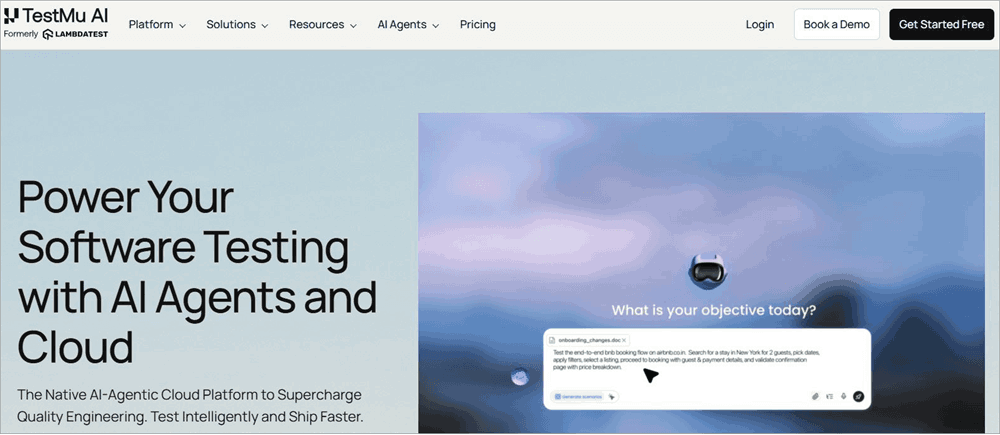
The platform is AI native by design. As such, it will facilitate the testing of web, mobile, and enterprise applications at any scale across real devices, real browsers, and custom real-world environments.
TestMu AI was formerly known as LambdaTest. It became TestMu AI after it evolved from a cross-browser testing platform into a fully AI-native software testing cloud ecosystem.
Today, the platform has gained the trust of over 18000+ enterprise customers, which include prominent names like OpenAI, Microsoft, NVIDIA, etc.
Of course, TestMu AI’s core AI offerings ultimately make it worth checking out.
TestMu AI – Core AI Products
#1) KaneAI
Of all the products and services TestMu AI offers, KaneAI is perhaps the one that intrigues me the most.
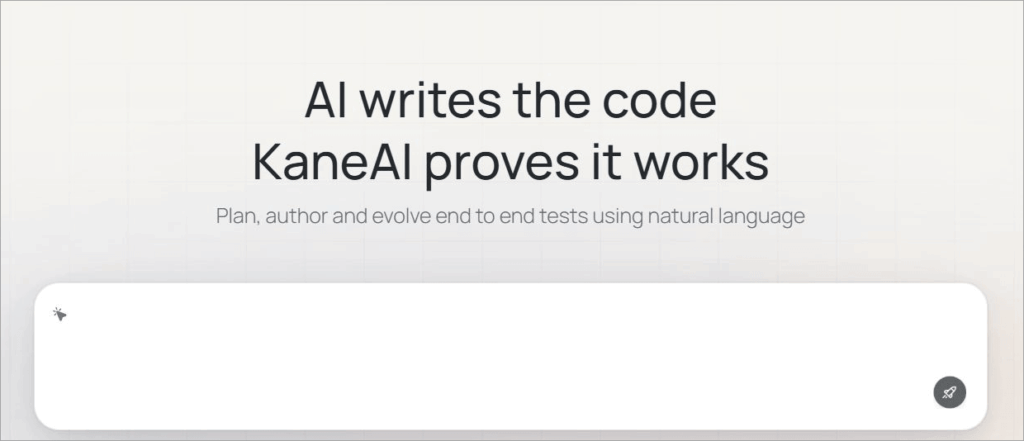
KaneAI can be best described as the world’s first GenAI native end-to-end software testing agent. Instead of writing complex scripts, all engineers need to do with KaneAI is describe what they wish to test in plain English. KaneAI will plan, author, execute, and self-heal the tests autonomously.
Here is a video for your reference:
Testing in Natural Language: With KaneAI, TestMu AI eliminates one of the biggest hurdles to traditional automation. Engineers can simply describe their testing requirements in natural language instead of wasting valuable time on writing and updating code. No coding or scripting is required. As such, this speeds up the time that one would normally need for test creation.
KaneAI also considerably improves accessibility for team members who may not possess the expertise required for handling automation.
Autonomous Self-Healing, Planning, and Execution: As an AI agent, Kane AI can plan and act independently. It can predict failures before they occur, understand the codebase, and conceive test strategies accordingly.
Changes to an interface can cause a test to fail; Kane AI, however, immediately detects this change and takes measures to repair the affected test without human intervention.
Kane CLI: Kane CLI is a testing agent that can be used for every use case and for any flow, e.g., browser automation, E2E automation, bug discovery, flow validation, DevTool asserts, test generation, etc.
Integration: As TestMu AI’s core offering, Kane AI integrates natively with the platform’s entire ecosystem. For instance, its integration with HyperExecute can prove beneficial when it comes to executing tests on a large scale. Its integration with Browser Cloud can offer you a browser execution layer.
All of these integrations do help engineers plan, execute, and analyze tests in a more streamlined fashion.
#2) HyperExecute
HyperExecute is an AI-native end-to-end test orchestration cloud that can make test execution run 70% faster. It offers features like test splitting & job prioritization. It captures full logs, videos, and screenshots per test. It allows grouping related jobs under a named Project.
#3) Agent Testing
The traditional testing tools we have out there are not capable or advanced enough to test AI agents. They are either too slow, too scripted, or unable to comprehend AI’s unpredictable behavior.
This is an issue that TestMu AI solves with Agent Testing.
Testing AI with AI: TestMu AI deploys AI agents to test other AI agents. These deployed agents can simulate real user conversations, edge cases, and adversarial situations at scale.
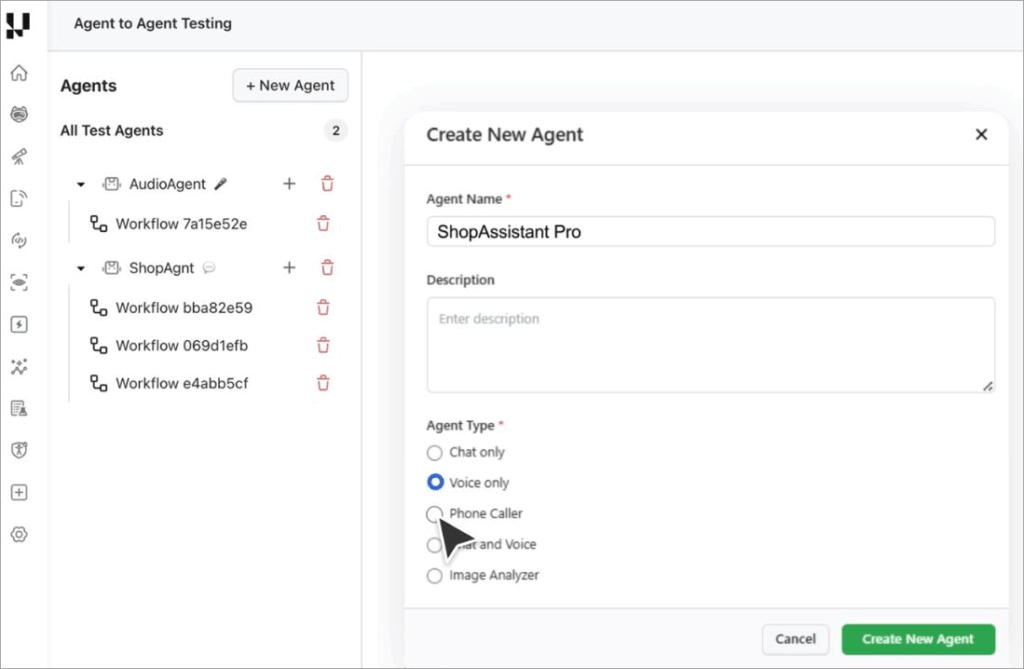
Below are just a few examples of every agent type covered:
- Chat and Voice Agent: All conversations are scored across 9 quality metrics.
- Phone Caller Inbound Agent: IVR systems and inbound support bots were tested via real phone calls and scored over 30+ metrics.
- Phone Caller Outbound Agent: Outbound sales dialers and proactive outreach agents are evaluated with dedicated number pooling and passive monitoring
- Image Analyzer Agent: Score AI-generated images based on prompts, technical specs, and brand guidelines.
Engineers can rely on this capability to test AI responses for:
- Accuracy
- Hallucination
- Consistency
- Tone
- Task Completion
Companies or enterprises launching AI products cannot simply rely on traditional testing methods. AI products need AI testing, and this is where TestMu AI’s Agent testing capability comes into play. It helps enterprises ensure that their AI products can function reliably in the real-world once launched.
I believe this feature is and will continue to be a critical requirement for any team shipping AI-facing products. As such, any enterprise building AI products is bound to have an advantage with TestMu AI by its side.
#4) Real-Device Cloud
An application must be tested across different operating systems, screen sizes, devices, and hardware systems to ensure it performs consistently well, regardless of the environment.
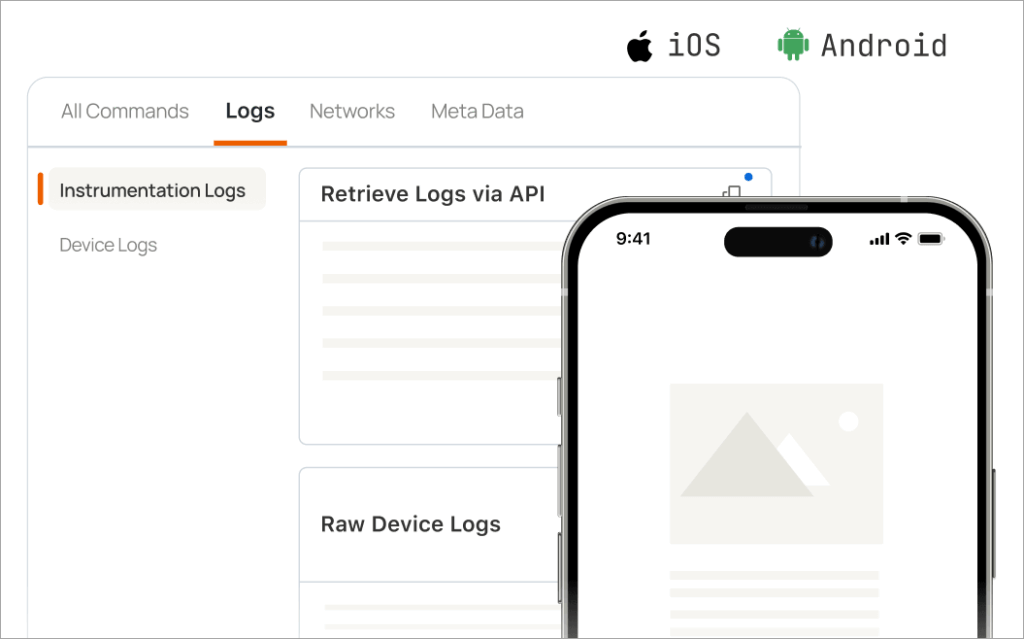
TestMu AI addresses this concern by offering your team on-demand access to over 10,000+ devices, real iOS and Android devices, alongside real macOS and Windows desktop environments, in the cloud to test mobile and web applications in real-world conditions.
Test on Real Devices, Not Simulators: Most simulators and emulators cannot replicate natural network behavior, GPS capabilities, or accessibility features. So, instead of relying on them, TestMu AI basically lets you perform tests on actual hardware in the cloud.
This can result in the unearthing of issues concerning battery behavior, real-world performance, hardware-specific rendering issues, network conditions, and OS-level quirks. It can basically help you capture issues with an app that most emulators often miss.
You get on-demand access to over 10,000 real Android and iOS devices for mobile app testing. You can also access a live Windows or macOS Sequoia machine in the browser and interact with its apps in real-time.
You get extensive device coverage, which includes access to both older, legacy models and the latest flagship products such as the iPhone 17 Pro Max, Samsung Galaxy S26, etc.
Advanced Testing Capabilities
You can rely on TestMu AI for advanced testing on real devices, which includes capabilities like:
- Network Throttling
- Simulating Biometric Authentication
- Image Injection
- GPS Simulation
- Accessibility Testing
The software supports manual live testing. For instance, you can test an app with real gestures (tap, zoom, pinch, rotate, etc) on real devices.
Furthermore, the platform also supports automated testing via Espresso, XCUITest, Appium, Detox, Playwright, Jenkins, GitHub Actions, etc.
Enterprise-Grade Security: TestMu AI offers enterprise-grade security to ensure your data remains safe as you test applications on real devices in the cloud. The platform ensures SOC 2 Type II, ISO 27001, and HIPAA-Ready compliance. The platform encrypts all device sessions and data transfers in transit.
Free Testing Each Month: You can use TestMu AI for real-device testing each month without charge or without submitting your credit card details. All you need to do is:
- Sign
- Choose a real Android or iPhone device from the dashboard
- Install the app from a public URL, store, or local upload
- Start a live session.
The free tier covers manual live testing as well as automated testing via Espresso, Appium, Detox, and XCUITest.
#5) Browser Cloud
Browser automation has always been a challenge, owing to the tedium of extensive infrastructure management. TestMu AI essentially overcomes this with its product Browser Cloud, a scalable browser infrastructure built for AI agents to scrape, test, and automate without any infrastructure headaches.
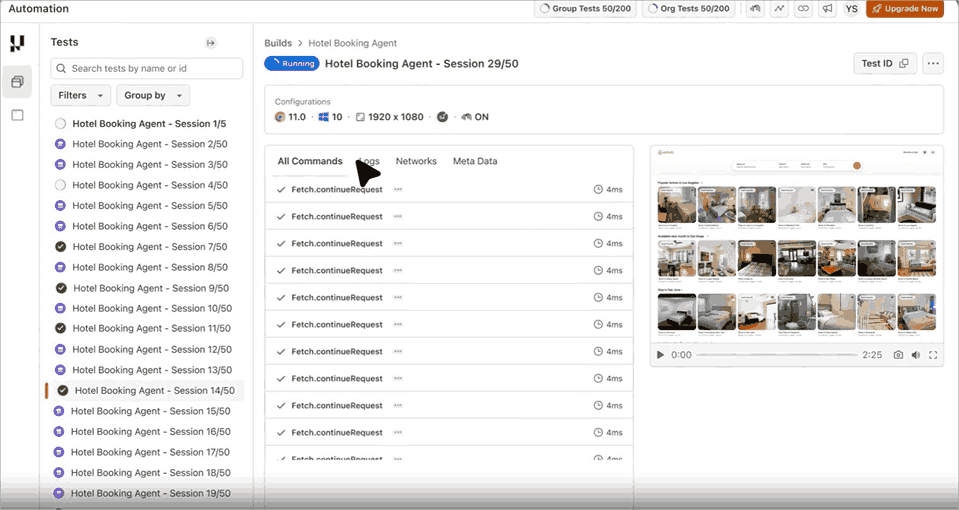
Browser Cloud runs on the same infrastructure that has powered TestMu AI for over a decade while serving 2.5M+ users and 15K+ enterprises globally.
Instantly Spin Up 100s of Browsers: Browser Cloud can help your team launch 100s of headless browsers on demand via SDK. With sessions lasting 24 hours and sub-second starts, the infrastructure facilitates large-scale automation, as you’ll be able to scale from one agent to thousands without indulging in capacity planning.
Another thing I like about Browser Cloud is the fact that there is no framework lock-in. It works just fine with Puppeteer, Playwright, Selenium, or any AI agent connected directly via SDK.
Advanced Features
Browser Cloud is further bolstered with built-in stealth features such as:
- Fingerprint Masking
- Ad Blocking
- CAPTCHA Solving
These advanced anti-detection techniques help your AI agent travel through the live web in the guise of a real user.
It also facilitates full session observability, basically letting you see everything your agent sees via:
- Video Replays
- Console Logs
- Complete Network Capture
This way, you have all the details necessary to debug any issue in no time to ship without delay.
Session persistence is yet another feature that lends Browser Cloud its distinct appeal. All cookies, local storage, and login state are carried over with every session. As such, agents can resume exactly from where they left off without re-authentication.
Browser Cloud also distinguishes itself from many of its competitors by offering a built-in local tunnel that can test locally-hosted apps and workflows behind firewalls and VPNs.
A Browser Infrastructure for AI Agents: You can rely on Browser Cloud to handle a variety of browser tasks. For instance, you can leverage it for QA automation against real browsers. You can test real checkout flows, UI rendering, and JS execution across thousands of real browsers.
This scalable infrastructure also provides AI agents with a production-grade browser to navigate, interact, and complete tasks on the live web.
The browser can also help you pull fully rendered structured data from any SPA or JS-heavy page. You get a real expected DOM instead of empty HTTP responses.
You can also count on this browser to automate multi-step workflows. It can handle CSRF tokens, cookies, and client-side transitions automatically. You log in once and stay logged in.
AI-Native Test Analytics and Intelligence
By now, you already know how highly I think of TestMu AI’s testing capabilities. It is equally great for producing analytics that give you insight into your test’s performance. Once a test is conducted, you can easily access comprehensive stats pertaining to it from the dashboard, thus making it easier to track releases.
The platform’s AI can detect flaky tests, run root cause analysis, cluster failures, and forecast which tests are most likely to fail in the future. You are then provided with a report with details on runtime, pass/fail rate, coverage, and trends.
Thanks to the platform’s AI-native intelligence and test analytics, your teams can make data-driven decisions to run flawless tests.
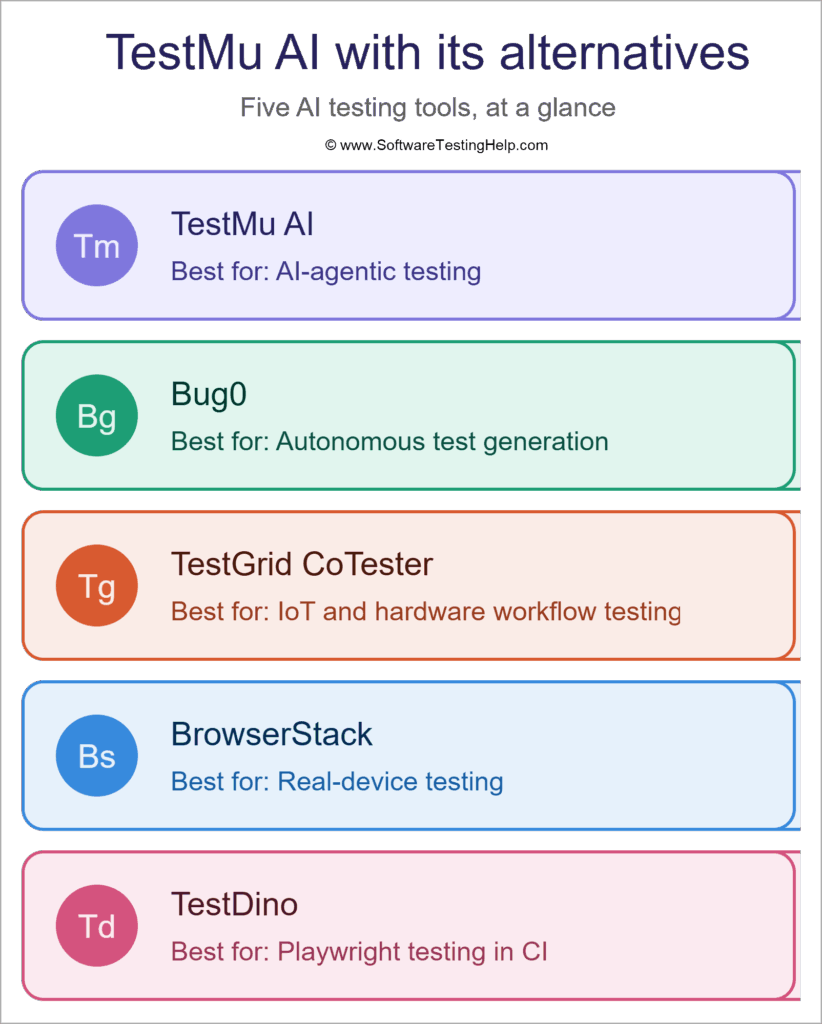
Best TestMu AI Alternatives
Here are some of the most popular Alternatives to TestMu AI:
- Bug0
- TestGrid
- BrowserStack
- TestDino
Comparing TestMu AI With its Competitors
| Name | Best for | Core Capabilities | Price |
|---|---|---|---|
| TestMu AI | AI-agentic testing | Kane AI, HyperExecute, Agent Testing, Real Device Cloud, Browser Cloud | Depends on the AI agent and plan duration |
| Bug0 | Autonomous test generation | Self-healing execution and human-verified results | Starts from $2500/month |
| TestGrid CoTester | IoT and hardware workflow testing. | Instant test creation, Self-healing capabilities, Vision language intelligence | Starts at $199/seat/month. |
| BrowserStack | Real-device testing | Manual cross-browser testing, browser automation grid, agentic testing in an IDE | Starts at $29/month |
| TestDino | Playwright testing in CI | Live Run, 1-click trace viewer, MCP server | Starts at $49/month to execute 25,000 tests. |
Detailed Reviews:
#1) Bug0
Bug0 is a platform that offers full end-to-end test coverage. All you need to do is provide the platform’s engineers with your staging environment. Bug0 takes care of the rest, which includes analyzing the app, planning coverage, and generating Passmark-based test scripts.
Price: Starts from $2500/month
Website: https://bug0.com/
#2) TestGrid
Like TestMu AI, TestGrid also offers an enterprise-grade AI agent called the CoTester to help developers and QA teams with their software testing endeavors. The agent carefully assesses your product’s context and QA workflow and then authors all the test code. You can count on it for instant test creation and self-healing capabilities.
Price: Starts at $199 per seat/month
Website: https://testgrid.io/cotester
#3) BrowserStack
This is yet another impressive platform that you can rely on for website and mobile app testing with AI to assist you throughout the testing lifecycle. The platform can help you perform an array of tests, ranging from accessibility testing to agentic testing in your IDE. BrowserStack does a good job of helping its users achieve reliable test automation at scale.
Price: Starts at $29/month
Website: https://www.browserstack.com/
#4) TestDino
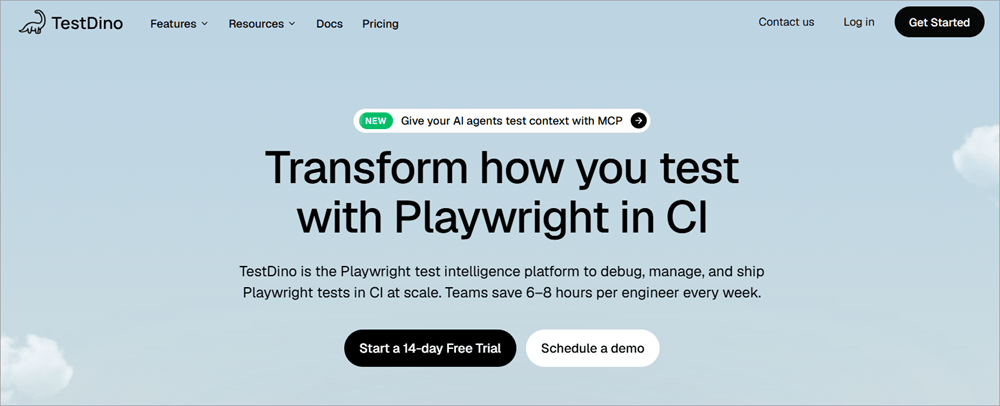
TestDino distinguishes itself from TestMu AI and its contemporaries by being a Playwright test intelligence platform. It basically lets you debug and manage Playwright tests in CI at scale. You are also provided with an MCP server for AI-assisted debugging.
Price: Starts at $49/month to execute 25,000 tests.
Website: https://testdino.com/
What Makes TestMu AI Stand Out
1. AI Native By Design, Not Bolted In: Being AI-Native by design is a distinct aspect of TestMu AI’s identity. Most vendors tend to add AI features on top of their existing platforms. That isn’t the case with TestMu AI. The platform offers you a holistic ecosystem that connects the dots across the broken pieces of software development.
2. Multi-Agent Intelligence: Thanks to multi-agent collaboration and deep context understanding, TestMu AI is proactive in its approach to quality engineering. Its AI agents don’t just execute but also understand codebases, assess testing strategies, and predict failures before they occur.
3. Analyst Recognized: Since its inception, TestMu AI has managed to earn itself a solid reputation alongside an array of accolades. The platform was named a Challenger in the 2025 Gartner Magic Quadrant. TestMu AI was also recognized in the Forrester Wave: Autonomous Testing Platforms, Q4 2025.
4. Zero Disruption to Workflows: TestMu AI supports Cypress, Selenium, Playwright, and Appium scripts without requiring any form of modification. The platform also facilitates over 120 integrations. This includes Jenkins, Slack, GitHub, etc. You can incorporate TestMu AI into your existing workflow without causing any disruptions.
TestMu AI Pricing
The price you pay for TestMu AI’s products will depend on the offering you pick, the plan you choose, and the number of parallel sessions you seek.
The plans are as follows:
Kane CLI
- Starter: $19/month
- Pro: $99/month
A free forever plan and a custom enterprise plan are also available.
KaneAI
- KaneAI (Web): $249/month/ agent
- KaneAI (Web and Mobile): $349/month/agent
A free forever plan and a custom enterprise plan are also available.
Test Manager
- Premium: $59/month/seat
A free forever plan and a custom enterprise plan are also available.
Agent Testing
- You’ll need to contact the sales team for a quote.
Live Testing
- Virtual Live: $19/month
- Real Device Plus Live: $49/month
A free forever plan and a custom enterprise plan are also available.
Browser Cloud
- Price starts at $29/month, billed annually.
A free tier and a custom enterprise plan are also offered.
You can sign up and start using the platform with the freemium plan. You’ll get 2 sessions of limited testing time for live testing usage. This privilege is renewed each month. Plus, you can upgrade or downgrade your plan anytime.
User Reviews and Ratings of TestMu AI
TestMu AI has generated a good amount of positive buzz and rave reviews since its inception. It has earned a respectable score of 4.6/5 on Capterra and 4.5/5 on Gartner. Most clients speaking positively about the platform highlight the tool’s user-friendliness when it comes to test automation and management.
Ratings at a Glance
| Capterra | 4.6/5 |
| Gartner | 4.5/5 |
| TrustRadius | 8.9/10 |
| Software Advice | 4.6/5 |
Pros and Cons
| Pros | Cons |
| Autonomous testing and planning | Some users may experience a steep learning curve. |
| Multi-Modal AI Agents | Some users, especially startups and freelancers, may find the plans expensive. |
| Plain English Test Authoring | The UI can become a bit sluggish when handling large testing requirements. |
| Test on real iOS and Android devices | |
| Test AI Agents with AI Agents | |
| AI-native test analytics | |
| Supports 120+ integrations | |
| Free tier for most of its AI products |
Frequently Asked Questions
1. What is TestMu AI known for?
TestMu AI (formerly known as LambdaTest) is the world’s first full-stack AI quality engineering platform. The platform offers an AI-native ecosystem that entails KaneAI for test creation, a real-device cloud for testing on thousands of real mobile and computer devices, a scalable browser infrastructure, and agent testing to test AI systems.
2. How is TestMu AI different from LambdaTest?
TestMu AI and LambdaTest are the same. TestMu AI previously went by the name LambdaTest when it was primarily known for cross-browser testing. As the platform expanded its capabilities to now offer a full AI-native testing stack, it became TestMu AI. All LambdaTest’s core capabilities can be found in TestMu AI alongside the new AI testing products.
3. What is KaneAI?
KaneAI is a Gen AI-native testing agent that quality engineering teams can use to plan, author, and evolve tests. Instead of complex scripting, Engineering teams simply need to describe what needs to be tested in plain English and let KaneAI take care of the rest.
4. Why test on real devices instead of relying on emulators?
Although emulators are great for fast unit-level checks, they stumble when it comes to testing an app for battery drain, GPU rendering, push notifications, biometric prompts, etc. Real device testing can help you identify issues with an app that most emulators are known to miss.
5. What are parallel sessions?
Parallel Sessions in the context of TestMu AI refer to the number of tests you can run simultaneously on the platform. For instance, if you’ve opted for 2 parallel sessions, this means either two members from your team can run live tests simultaneously or a single member can run two tests at the same time.
6. How does HyperExecute compare to Selenium Grid?
HyperExecute is an AI test orchestration platform offered by TestMu AI that is capable of running tests at a considerably faster pace than Selenium Grid.
This is because Selenium Grid entails multiple network hops per command, which results in high network latency.
HyperExecute offers a unified execution environment to group, distribute, and execute scripts, whereas Selenium Grid mainly serves as a proxy server. Another key distinction between the two lies in the frameworks they rely on. Selenium Grid is strictly Selenium-based. On the other hand, HyperExecute relies on Playwright, Cypress, Puppeteer, etc.
HyperExecute also has an edge over Selenium Grid because of its AI capabilities.
Conclusion
As the world’s first agentic AI-quality engineering platform, there is just so much to adore about TestMu AI. This is exactly the kind of platform modern engineering teams need to test emerging applications at any scale.
The benefits you get from the platform are limitless. For starters, it is AI-native by design. It facilitates natural language testing via KaneAI. You can rely on it to deploy AI agents to test AI systems. You also benefit from a solid integration ecosystem with enterprise-grade security.
It is a software I would recommend to developers and quality engineering teams that wish to build, validate, and ship their software at a much faster pace.
Research Process: The total time involved to complete and publish this article is approximately 42 hours. This content was created through a structured research approach to ensure accuracy and reliability.
For more-related guides, you can explore our range of tutorials below:
- 7 Basic Quality Tools: Best Quality Management
- What is Software Quality Assurance (SQA): Complete Guide
- Difference Between Quality Assurance and Quality Control (QA vs QC)
- 10 Steps To Improve Software Quality By Improving Process
- Kuality.io AI Testing QA Platform Hands-on Review
- Granola AI Review: AI Note Taker for Meetings
- Is Joyland AI Safe? Review and Alternatives
- Atlassian Rovo AI-Powered Solution Review
Was this helpful?
Recommended Reading
-

Level up your programming game with the top-notch AI coding tools. Compare the prominent AI code generators to pick the right AI tool for coding to boost code quality: With the revolutionary change of artificial intelligence, the way software developers and engineers work has completely changed. Writing code, debugging, interacting…
-

Enhance your hiring process with the top AI Recruiting tools in the market. Use the right AI recruitment software to simplify and automate multiple hiring tasks quickly and smartly: Recruitment is the most challenging function an organization must tackle for its survival and growth. Ask any professional tasked with recruiting…
-
A noteworthy ChatGOT review, along with the top ChatGOT Alternatives. Compare the features, performance & pricing of each tool to pick your ultimate AI-driven Chat Assistant: ChatGOT is perhaps one of the most sought-after platforms for people experimenting with different AI models. This SaaS platform serves as a central hub…
-
Are you looking for a perfect website builder for your business? Read our honest review of Durable AI website builder with alternatives to build a smart website of your choice in minutes: Thanks to so many no-code platforms today, creating a fully optimized website is no longer an arduous endeavor.…