


Create an ultimate B2B Customer Journey Map with this step-by-step guide. Understand what is B2B Customer Journey with the top tools to drive excellent results:
Every company should understand the needs and emotions of its customers in order to address their requirements to build stronger & long-term relationships efficiently.
There are certain stages through which a customer passes during the buying process, including discovering your company, researching and comparing solutions, what influences their decision to engage, and how they experience your product or service after becoming a customer.
B2B Customer Journey Mapping: Complete Guide
Sometimes, despite the sales team’s hard work in nurturing the lead, it falls away. It could be due to a lack of understanding that the team missed the connection. To solve this issue, here comes the “B2B customer journey mapping”.
In this article, we covered everything related to B2B customer journey mapping, including all subtopics like what a B2B customer journey is, how to create a B2B customer journey map, challenges in making the journey maps, and so on.
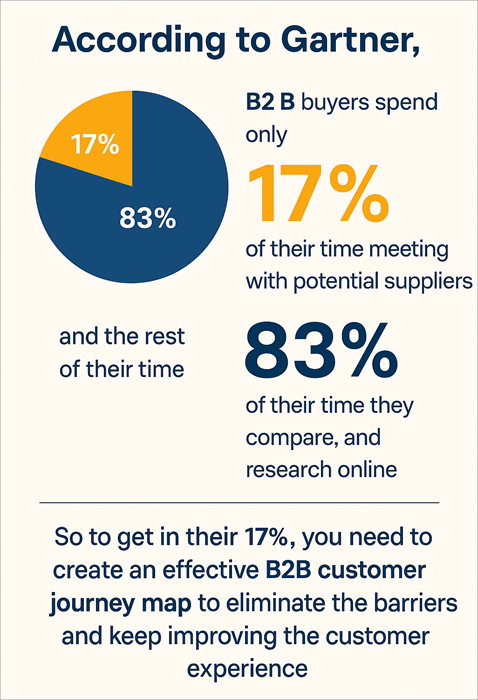
According to Gartner, B2B buyers spend only 17% of their time meeting with potential suppliers, and the rest 83% of their time they spend comparing and researching online. So, to get to their 17% you need to create effective B2B customer journey maps to eliminate the barriers and keep improving the customer experience.
The diagram below shows the results of the Gartner report:
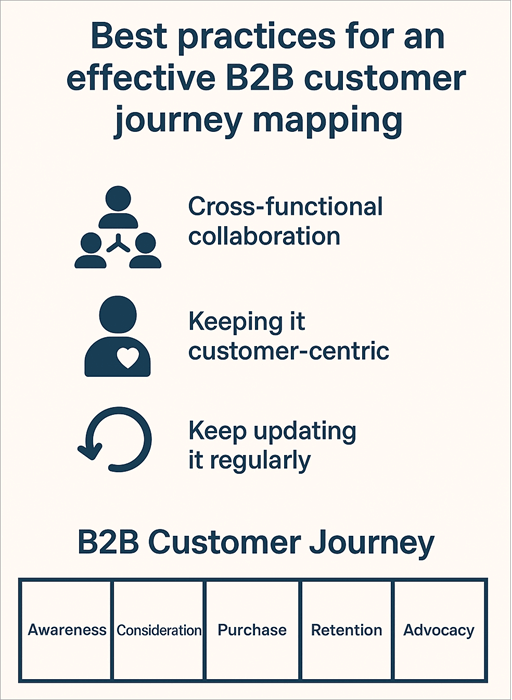
B2B Journey Mapping Best Practices 2026: The best practices for an effective b2b customer journey mapping are: cross-functional collaboration, keeping it customer-centric, and keeping it regularly updated. It must also draw a brief and clear diagram or table to show the stages.
The best practices of B2B Customer Journey Mapping are depicted below:
What is a B2B Customer Journey Map
A B2B customer journey map outlines all the stages a customer goes through from awareness of your company to their retention. It involves customer actions, touchpoints, their thoughts & emotions, pain points, and so on.
In short, it’s a strategic tool through which a company can understand the customer at each stage to address their needs more effectively, remove barriers, and build stronger and longer relationships.
B2b customer journey mapping depends on the type of business and the needs of clients. It is used to highlight opportunities, reveal challenges, improve conversations, align teams, build loyalty, and so on.
There are certain challenges that the company faces while preparing the customer journey maps, like there is a challenge in capturing accurate data on multiple perspectives, writing a clear and balanced process.
Integrating the customer journey map with platforms like CRMs, market automation, and analytics tools can enhance its efficacy.
- CRM: By integrating the maps with certain CRMs like Salesforce, HubSpot, Zoho, etc, you can have centralized customer data, a 360° view of the customer, triggered-based actions, dynamic grouping of journey stages, and much more.
- Marketing Automation Platforms: With the integration of marketing automation platforms, you can automate touchpoints, lead scoring, nurturing, and so much more. The examples of marketing automation platforms are Marketo, ActiveCampaign, etc.
- Analytics Tools: These tools provide you with all the essential insights. It provides web & app analytics, BI and data visualization, attribution models, customer feedback, and so on. You can check our detailed review of the top Customer Feedback software to choose from.
How to Create a B2B Customer Journey Map
To create an effective b2b customer journey map, you need to follow the given steps:
Step #1: Evaluating the need and clarifying the goal: The first and foremost task is to evaluate the need to clarify exactly what you want or what would be the goal of creating a b2b customer journey map. It could be to improve lead nurturing, enhance onboarding, reduce churn, or understand decision-making patterns.
Step #2: Identify the Target Customers: Now, you need to identify the type of customers you want to target as per your business needs. Include their industry, role, responsibilities, goals, challenges, and buying motivations.
Step #3: Journey Stages: Now you need to decide and draw the buying stages of the customers as per the goal.
It could be as follows:
- Awareness
- Consideration
- Decision
- Onboarding
- Retention
Step #4: Visualization: Create an effective table or diagram to represent the customer’s buying journey or customer journey map. The map must not be complex; avoid adding excess details that make the map overwhelming. You should just list out the important facts that can be used and acted upon later.
Step #5: Document Interactions or Touch points: Now you need to list all the interactions that have been made with the customers directly or indirectly via website visits, sales calls, proposals, demos, trade shows, or support emails, etc.
Step #6: Emotion Element: Don’t forget to mention what the customer is thinking, their thoughts, and feelings at each stage. It would help you eliminate any doubts or frustrations of the customers.
Step #7: Evaluate or Identify the Pain points: At each stage, keep searching for any pain points or doubts, or barriers like unclear pricing, slow responses, or complex approvals that could create a hindrance in the buying journey of customers.
Step #8: Improvements: After identifying the pain points, you need to suggest improvements to eliminate the obstacles and make the customer journey smoother. It could simplify proposals, improving content, offering tailored demos, or enhancing post-sale support, etc.
Step #9: Use accurate and Actual data: Sometimes the team considers assumptions as their insights, which are not correct and could lead to a misleading picture of the customer’s journey. Instead, base your mapping on accurate data taken from interviews, surveys, etc.
Step #10: Keep checking for any updates: You need to keep the map and insights updated as the market trends do keep changing, the needs of customers fluctuate, and your process evolves.
Example of a customer journey map based on points as discussed above:
| Stage | Customer Actions | Touchpoints | Customer thoughts and emotions | Pain points | Opportunities for improvement | Metrics/KPIs |
|---|---|---|---|---|---|---|
| Awareness | Reads industry blogs, attends trade shows, listens to podcasts, visits website | LinkedIn ads, blog articles, industry webinars, conference booths | “Do they understand my business challenges?” | Overwhelming amount of information from multiple vendors | Provide industry-specific content, case studies | Website visits, ad click-through rate |
| Consideration | Compares vendors, requests demos, downloads whitepapers | Sales calls, email follow-ups, product brochures, demo requests | “Will this solution meet our needs and justify the cost?” | Lack of tailored demos, unclear differentiation | Offer personalized demos, competitor comparison guides | Demo request rate, proposal acceptance rate |
| Decision | Reviews proposals, negotiates terms, gains internal approvals | Proposal documents, pricing meetings, contract discussions | “Is this the best choice for our ROI?” | Long approval cycles, unclear ROI metrics | Provide ROI calculators, streamline proposal process | Time-to-close, deal conversion rate |
| Onboarding | Attends training, configures product, assigns internal teams | Training sessions, onboarding calls, setup documentation | “How quickly can we get this running?” | Overwhelming learning curve, delayed setup | Create quick-start guides, assign onboarding specialist | Time-to-productivity, onboarding completion rate |
| Retention | Uses product, requests support, shares feedback, refers other businesses | Support tickets, account reviews, loyalty programs | “Do they still value us after the sale?” | Slow support response, lack of follow-up | Offer regular check-ins, customer success programs | Renewal rate, referral rate |
Types of B2B Customer Journey Maps
The b2b customer journey maps are of different types based on the motive of the business. It could be for understanding the present, designing better experiences, or aligning internal workflows, etc.
1. Five-stage Model: It includes a five-stage funnel. Where the customer starts from its first stage, Awareness, then goes to Consideration, then Decision-making, then Onboarding, and finally Retention.
| Awareness | Consideration | Decision | Onboarding | Retention |
2. Six-stage Model: It includes six stages of the funnel wherein the client starts from the stage of Awareness, then goes to Interest, Consideration, Decision-making, Onboarding, and lastly retention.
| Awareness | Interest | Consideration | Decision | Onboarding | Retention |
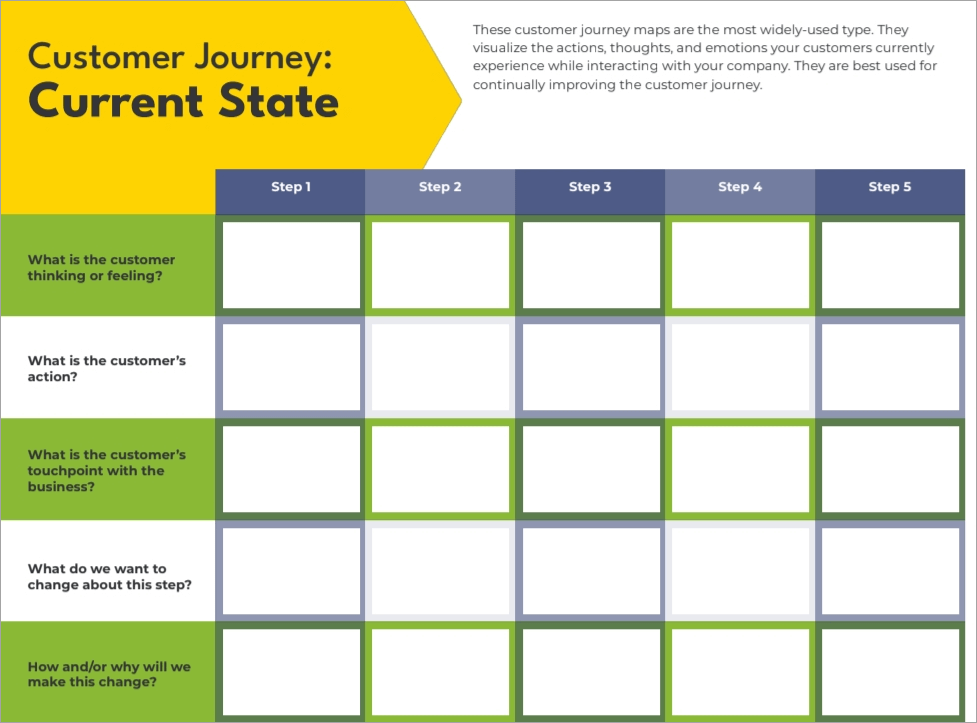
3. Current-state Map: It is a type of map that focuses on current actions. It includes interactions, thoughts, and feelings of customers as of today.
Given below is an example of Customer Journey Current-state Map:
[Via BizzyWeb]
| Awareness | Consideration | Decision | Onboarding | Retention | |
| Brand touchpoints | |||||
| Feedback and painpoints | |||||
| Customer emotions | |||||
| Opportunities and solutions |
4. Future-state Map: It is the type of map that focuses on future experiences. It includes ideal customer future experiences, helping guide for improvement, or we can say long-term planning.
An example of the Future-state map is depicted below:
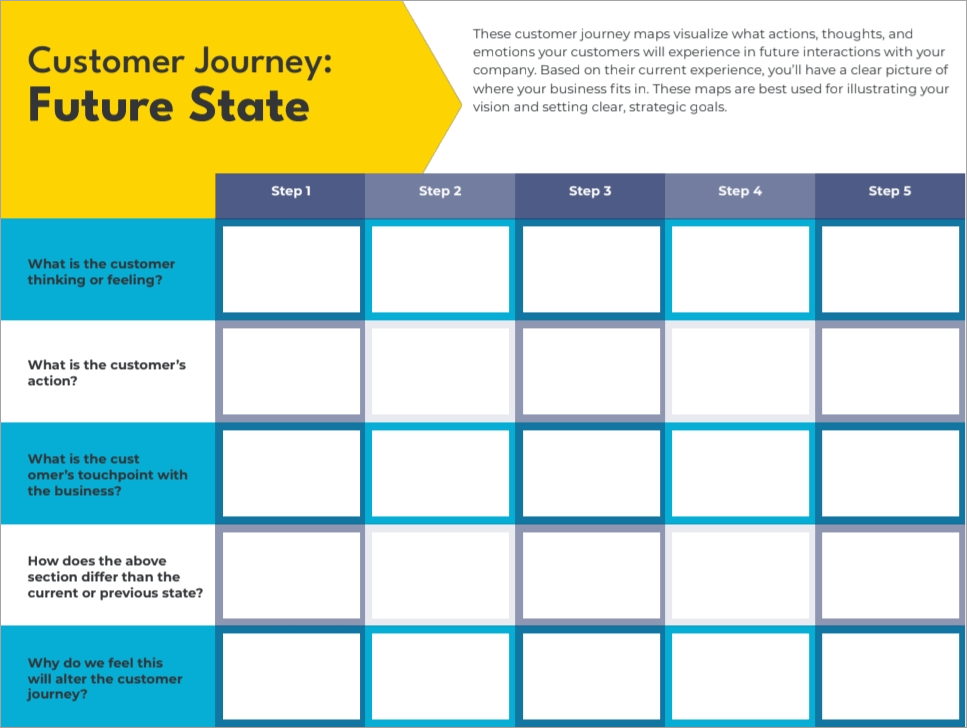
| Awareness | Consideration | Decision | Onboarding | Retention | |
| Brand touchpoints | |||||
| Explanation of change and goals | |||||
| Customer emotions | |||||
| Why will this be beneficial? |
5. Day-in-the-Life Map: This type of customer journey map focuses on a customer’s typical day. It includes needs, habits, and challenges that could influence how they engage with your business, as well as identifying customer needs and creating new marketing strategies.
Here is an example of Day-in-the-Life map:
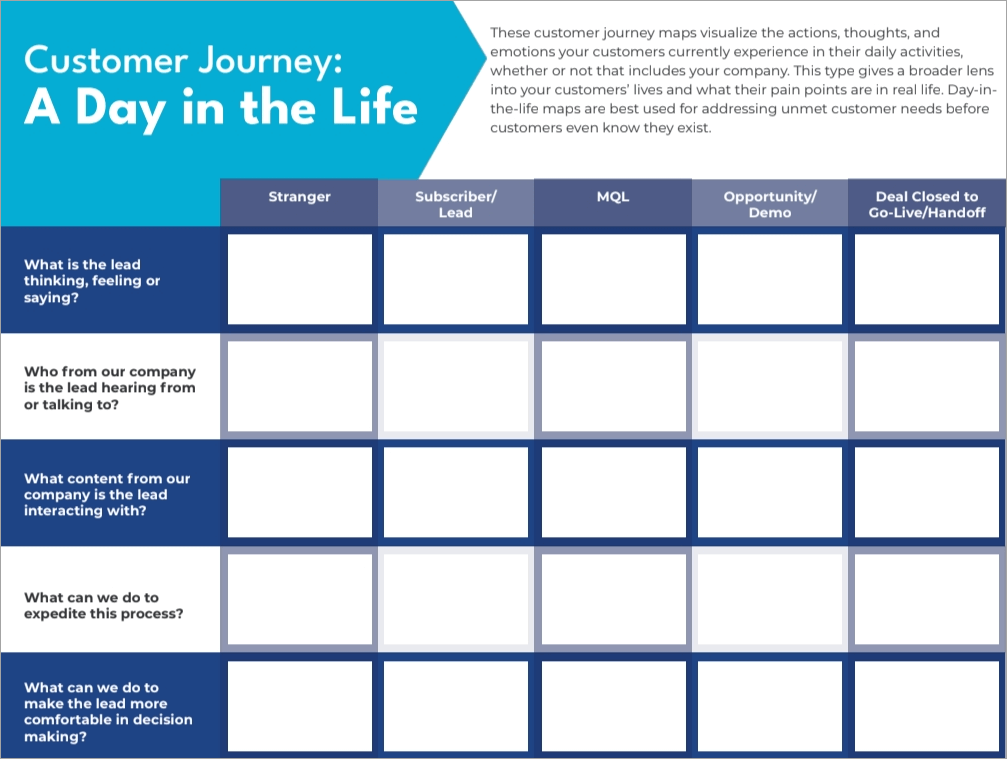
| Customer profile | 8:00 am | 9 am | 10 am | 11:00 am | 12:00 pm | 1:00 pm | 2:00 pm | 3:00 pm | 4:00 pm | 5:00 pm |
| Description and goals | ||||||||||
| Brand touchpoints | ||||||||||
| Customer emotions | ||||||||||
| Identified needs | ||||||||||
| Possible solutions |
6. Service Blueprint: In this customer journey mapping, along with the customer journey, the teams’ services and support are included. It specifies the service of each team to the specific roles, technologies, processes, or policies that each step requires.
| Awareness | Consideration | Decision | Onboarding | Retention | |
| Customer actions | |||||
| Frontstage (visible team actions) | |||||
| Backstage (invisible team actions) | |||||
| Support process | |||||
| Evidence |
Need For Customer Journey Mapping
Customer journey mapping helps businesses in many ways.
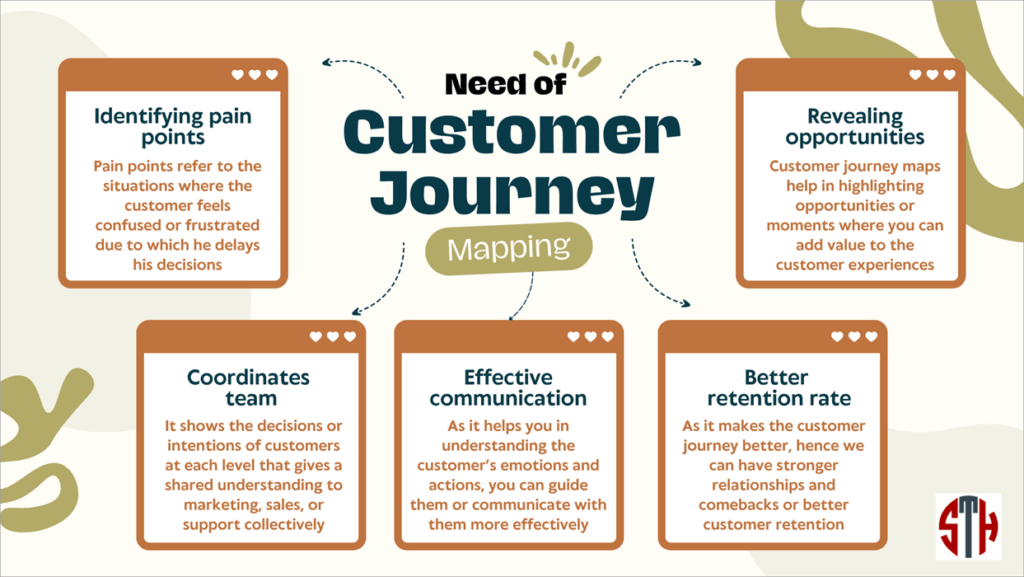
It helps in:
- Identifying Pain Points: Pain points refer to the situations where the customer feels confused or frustrated due to which delays their decisions.
- Revealing Opportunities: Customer journey maps help in highlighting opportunities or moments where you can add value to the customer experience.
- Coordinates Team: It shows the decisions or intentions of customers at each level, which gives a shared understanding to marketing, sales, or support collectively.
- Effective Communication: As it helps you in understanding the customer’s emotions and actions, you can guide them or communicate with them more effectively.
- Better Retention Rate: As it enhances the customer journey, we can foster stronger relationships and achieve better customer retention.
Importance of B2B Customer Journey Mapping
There are many great benefits to using B2B customer journey mapping in your business.
Some of them are:
- Reduced Friction in Buying Process: As the map reveals all the pain points, actions, or thoughts at a single place, it would be of great benefit to the business to subside any unwanted actions.
- Better Understanding: It facilitates a better understanding of clients’ needs and each stage of their buying process by revealing their thoughts and actions.
- Consolidated View: It facilitates improved alignment across teams as it shows a consolidated view of the client’s journey at each level. The marketing, sales, and support teams can work collectively by using the consolidated view.
- Well-prepared Communication: The business teams can now communicate with the clients more effectively, as they now know the most impactful moments of the customer and how to offer the best.
- Enhanced Experience: The customers can have an enhanced buying experience as they can be understood better and will get better support at each level.
- Better Decisions: It facilitates more informed decisions as the business can now provide the required resources as per the insights from the customer journey map.
- Higher Retention Rates: As it enhances the customer experience and fulfills the expectations of clients at each level, the chances of them coming back and buying again is higher. Hence, it makes stronger and longer customer relationships.
- Cost Benefits: By using a customer journey map, you can have cost benefits to a great extent as it leads to reduced customer acquisition cost, higher conversion and win rates, improved customer retention, increased CLV, better resource allocation, and so much more.
Challenges Involved in Creating a Customer Journey Map
There are certain challenges in creating a customer journey map, like getting accurate data, clarity in customer behavior, fluctuating market trends, and so on.
- Accurate Data Collection: It is a challenge in itself to understand the thoughts of customers and gather accurate data for the map, as there are fluctuations in customers’ thoughts and values.
- Multiple Perspectives: It is difficult to draw a clear picture as the customer takes different options based on their fluctuating perspectives.
- Ambiguous Decision-making: It is difficult for a business to take notes as the customers in b2b business involve several parties that have different priorities.
- Keep up with the Trends: As the market trends and technology are ever-changing, so is the customer behavior; you need to keep updating the map regularly.
- Keeping it Simple & Effective: It is important to keep the map simple yet effective, as too much detail can make the map overwhelming, while too little can make it less useful for decision-making.
- Non-linear Journey Mapping: B2B customer journeys are rarely linear; they may move forward, repeat a stage, or go back. They do not fit in a one-direction funnel, so we need to make a dynamic and flexible map.
- Multiple Stakeholders & Persons: Unlike B2C, here the B2B customer journey involves multiple stakeholders and multiple personas or decision-makers that influence the buying process. They have different perspectives, conflicting goals, and they may overlap, diverge, and influence one another.
- Digital-first Journey Considerations: Now, the buyers research themselves and have AI-driven personalization under omnichannel continuity, where they may connect on LinkedIn or a website and expect not to lose the context.
Major Elements to Include in Customer Journey Maps
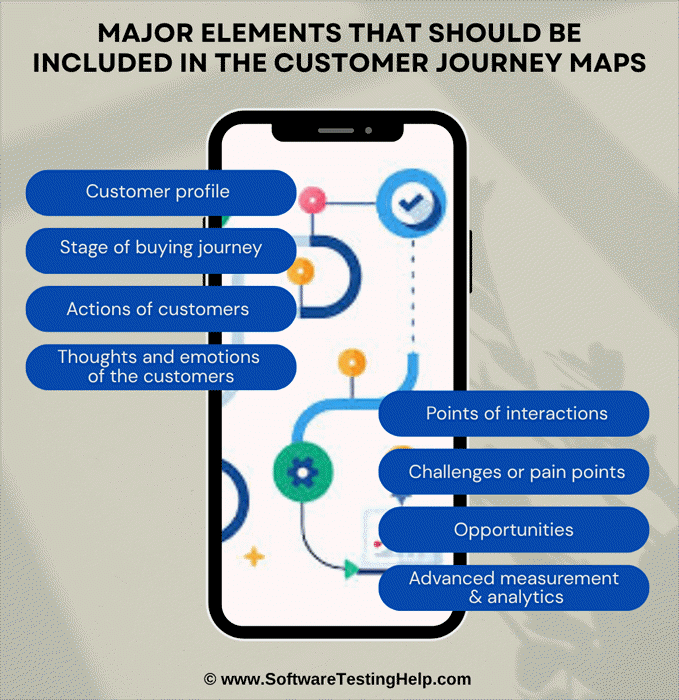
Certain elements must be taken into consideration while drafting a customer journey map that clearly shows how customers interact with your business and what they experience at each stage, which will eventually enable you to easily improve the customer experience.
The major elements are as follows:
- Customer Profile: The customer profile or their description, including their name, company’s name, needs, goals, and pain points, should be briefly mentioned.
- Stage of Buying Journey: It is the basic and most important element that should be carefully listed as per the type of map. It may include stages like awareness, consideration, decision, retention, etc.
- Actions of the Customers: The actions of the customers should be carefully studied and jotted down in the map to analyze them later for better understanding. It may include researching, comparing options, or contacting support for the customers.
- Thoughts & Emotions of Customers: Besides writing the actions of the visible customers, you should also list their emotions and thoughts at each stage, which will help you relieve their frustration and motivate them to buy your product.
- Points of Interaction: There are points where the customer and your brand interact with each other; they are called touchpoints. It may include website visits, emails, phone calls, or in-person meetings etc.
- Challenges or Pain Points: These are the elements that pose challenges or obstacles in the customer journey. It may include a lack of tailored demos, unclear differentiation, long approval cycles, unclear ROI metrics, etc.
- Opportunities: A section for opportunities for improvement should be included in the map to enhance the customer experience and remove barriers.
- Advanced Measurement & Analytics: It connects the visual insights with value and performance. It measures how journeys impact revenue, retention, and loyalty. It includes measures like customer lifetime value correlation, advanced KPIs (conversion rates, response times, etc). and so on.
Mistakes to Avoid in Creating a Customer Journey Map
- Considering Assumptions Instead of Accurate Data: Sometimes, the team considers assumptions as their insights, which are not correct and could lead to a misleading picture of the customer’s journey. Instead, they should base their mapping on accurate data taken from interviews, surveys, etc.
- Not Considering After-sales Services: Post post-sale stage is very crucial for long-term success, as this is the stage where you can retain the customers. Sometimes the team ignores this stage and loses the customers.
- Complex Structure: Avoid adding excess details that make the map overwhelming. You should just list out the important facts that can be used and acted upon later.
- Obsolete Details: When you do not update the details of the map, it gets obsolete as the customer needs, market trends, and processes constantly change, and you need to keep updating them for an effective result.
- Avoiding Emotional Element: The emotional factor must not be overlooked. It may be the key purchase driver of the customer as it ensures trust, reassurance, and ease of use.
Data Used in B2B Customer Journey Mapping Types
Under customer journey mapping, two types of Data are used:
- Quantitative Data: It reflects what the customer behavior is, with insights like conversion rates, usage frequency, time-to-close, and so on.
- Qualitative Data: It shows why the customer is showing any specific behavior. It includes insights like emotions, objections, expectations, and more.
Data Sources For Mapping
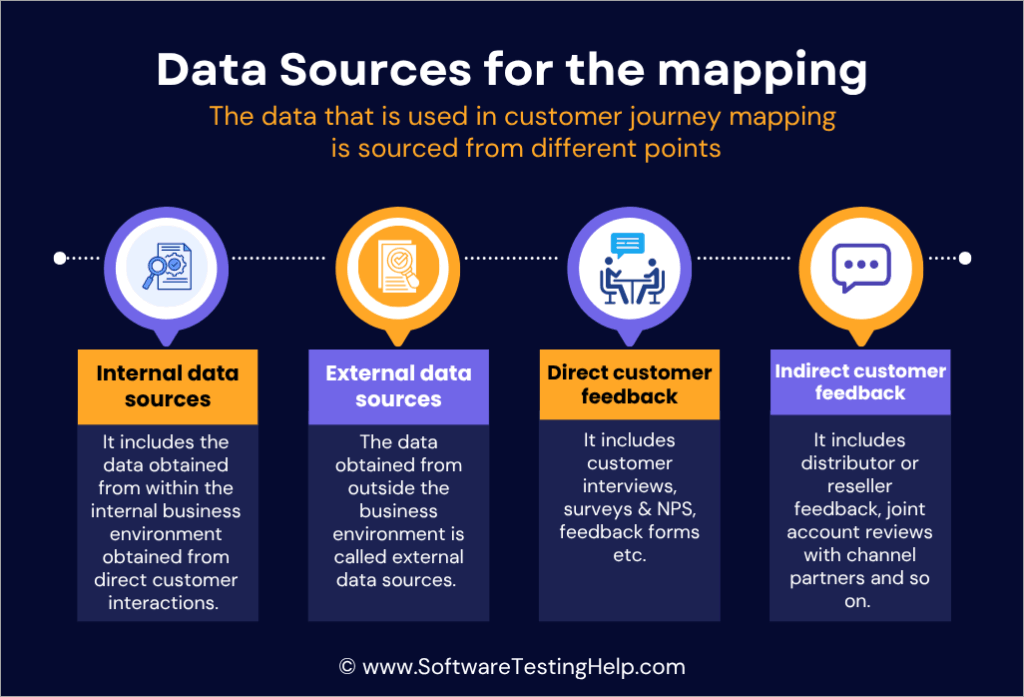
The data that is used in customer journey mapping is sourced from different points. It may be obtained within the internal business environment and from the external environment, depending on the type of data. The data can be obtained from:
- Internal Data Sources: It includes the data obtained from within the internal business environment, obtained from direct customer interactions. Like CRM systems, marketing automation platforms, website analytics, sales call and meeting insights, customer chat logs, etc.
- External Data Sources: The data obtained from outside the business environment is called external data sources. It includes industry reports, market research, social media listening tools, review and feedback platforms, competitor websites, and so on.
- Direct Customer Feedback: It includes customer interviews, surveys & NPS, feedback forms, etc.
- Indirect Customer Feedback: It includes distributor or reseller feedback, joint account reviews with channel partners, and so on.
B2B Customer Journey Map Template Free Download
Choose from the options below to download the B2B template free of cost that best fits your workflow.
- HubSpot
- Delve.ai
- BizzyWeb
- tlf research
Top Enterprise Customer Journey Mapping Tools
Various companies and tools help in creating a B2B Customer Journey Map. Some of the notable ones are reviewed below.
- Textmagic
- SurveyCXM
- Scalepods
#1) Textmagic
Textmagic is an all-around business communication tool that enables you to create an effective b2b customer journey map by helping you in campaign tracking & analytics, capturing touch points, coordinating responses across teams, etc.
Along with that, it also provides various other features like contact management, omnichannel chat widget, and so much more. We have a perfect compilation of the top contact management tools for you to pick from.
Website: https://www.textmagic.com/
#2) SurveyCXM
SurveyCXM is an advanced customer experience management tool that can help you in creating an effective b2b customer journey map by providing you with comprehensive metrics & dashboard insights, multichannel feedback collection, and more.
It will help you in examining the emotional element of the customers through parameters like NPS, CES, CSAT, eNPS, etc.
Website: https://surveycxm.com/
#3) Scalepods
ScalePods is an all-around business development tool that helps you in creating a smooth b2b customer journey map through refining ICPs and personas, structuring the post-sale journey, operationalising the customer journey, aligning cross-functional teams, and so on.
Along with that, it offers services like optimizing funnels, refining messaging, supporting outreach systems, building repeatable customer journeys, and so much more.
Website: https://scalepods.co/
Frequently Asked Questions
1. What are the key stages in a B2B customer journey?
The stages in a b2b customer journey depend on the motive of the business. The general stages in a b2b customer journey are:
• Awareness
• Consideration
• Decision making
• Onboarding
• Retention
2. How can journey mapping improve B2B sales and retention?
Customer journey mapping helps the business in b2b sales and retention to a great extent. It will help you in tailoring communications, streamlining processes, enhancing onboarding, and providing proactive support that could lead to better conversion and retention. Read through our exclusive review of the top Customer Onboarding Software to pick the right tool for your needs.
3. What are common mistakes to avoid when mapping the customer journey?
Certain common mistakes make the maps invalid or obsolete, and they can be avoided. These are: Considering assumptions instead of accurate data, not considering after-sales services, complex structure, obsolete details, and neglecting the emotional element.
4. What data sources are used for journey mapping?
All types of qualitative as well as quantitative data are used in journey mapping that can be obtained internally or externally.
• Quantitative data: It reflects what the customer behavior is, with insights like conversion rates, usage frequency, time-to-close, and so on.
• Qualitative data: It shows why the customer is showing any specific behaviour. It includes insights like emotions, objections, expectations, and more.
5. Can AI help improve B2B customer journey mapping?
With the help of AI you can enhance the digital B2B customer experience mapping to a great extent. You would get predictive analytics, personalization at scale, journey orchestration engines, sentiment & intent analysis, account-based insights, content recommendations, and so much more.
6. Which CRM systems integrate best with customer journey mapping?
CJM can be integrated with CRMs to enhance its efficacy.
The best CRMs are:
• Salesforce
• HubSpot
• Zoho
• Pega
• Microsoft Dynamics 365
If you are looking for the best CRM software, then read through our exclusive guide.
7. How long does it take to create an effective B2B customer journey map?
To create an effective B2B customer journey map, you would need a time of 2-3 months. It depends on company size, number of customer personas, data availability, and the organization’s existing journey research.
8. Who should be involved in creating a B2B customer journey map?
A B2B customer journey map involves departments such as marketing, sales, customer support, operations, the data team, and actual customers.
9. How much does B2B customer journey mapping cost?
The cost of a b2b customer journey map depends on whether you are getting it internally or through a consultancy. If you are getting it through a DIY approach, you would need approximately $5,000–$20,000, and with a consultancy, it would cost around $25,000–$150,000+ for enterprise-level mapping.
10. How do you map journeys for multiple stakeholders in B2B decisions?
For a Multi-stakeholder journey mapping, you need to follow the given steps:
Step 1: Identify the personas
Step 2: Create persona-specific micro-journeys
Step 3: Overlay them into an account-level journey map
Step 4: Highlight conflicts
11. What’s the difference between B2B and B2C customer journey mapping?
The B2B customer journey mapping is different from B2C customer journey mapping in terms of decision makers, journey length, and complexity. B2B has longer, multi-layered, rational decision-making, and B2C has shorter, emotional, and individual decision-making.
12. How often should you update your B2B customer journey map?
You should update your B2B customer journey map annually in a state of stability. If you update your product or if there is a shift in buyers’ behavior, then you must update it in 6 months.
Here is the video guide on how to make an effective Customer Journey map:
Conclusion
In essence, the B2B customer journey mapping is a strategic tool for driving growth, retention, and long-term partnerships. It turns the complex and fluctuating customer insights into a clear and readable form with accurate facts that can be used to eliminate pain points or obstacles and to smooth the customer journey experience.
There are many tools available in the market that help you in creating the B2B customer journey maps, like SurveyCXM is best in providing comprehensive metrics & dashboard insights, multichannel feedback collection, and more.
ScalePods is best in refining ICPs and personas, structuring the post-sale journey, operationalising the customer journey, aligning cross-functional teams, and so on. Hence, to accelerate revenues, you need to work on a proper customer journey map.
For more quick CRM-related guides, you can explore our range of Sales & CRM tutorials below:
- Top Sales Software Tools To Grow Your Business
- BEST Client Management Software of the Year
- Top Sales Enablement Tools to Look for
- Best Sales CRM Software Tools
Was this helpful?
Recommended Reading
-

Read the reviews to compare the best Customer Feedback Software platforms to collect online feedback from customers and improve the brand’s performance: Customer Feedback Software refers to a platform that helps in collecting customer feedback, finding gaps, and improving the customer experience. It comes with a variety of features like…
-
Comparison of top Customer Data Platforms with features, pros, cons, client details, etc. to identify the best CDP software as per your requirements: CDP stands for Customer Data Platform. It refers to the software that provides its users with the features like collecting and classifying customers' data, 360° view of…
-
List of the Top Online Customer Experience Management Software and Tools: What is Customer Experience (CX) Management? Customer experience management is the process that is used for designing and replying to customer’s feedback. This process will help you meet customer expectations and thereby improve customer satisfaction. Customer Experience software is…
-
In this article, we will explain Customer Onboarding software, its best tools, benefits, types, and steps for effective customer onboarding: We will discuss various facts with some expert advice and FAQs. We have provided a list of the best customer onboarding tools with their reviews. A comparison table is drawn…


