


Transform your child’s relationship with math through these top After-School Math Programs. These exceptional Tutoring programs teach Math with fun & real-world scenarios to equip aspiring students with vital skills:
Math isn’t just a subject for families investing in their children’s academic edge. It lays the foundation for future success in fields such as data science, engineering, and software development.
The right after-school math programs do more than teach basic computation. They help students develop advanced problem-solving skills, logical reasoning, and competition-level fluency.
Hand-Picked Math Education Programs After-School
Today’s top programs offer structured pathways taught by expert educators, whether you’re looking for enrichment, remediation, or long-term acceleration online or in person.
Knowing which are the best after-school math programs for students is essential to their educational success. With mathematical excellence, children enter the business world with much better analytical and strategic skills. It all starts with advanced math efforts.
The What and Why of After-School Tutoring for Math
Some students require extra support to keep up, whereas others desire more challenging coursework. With a shortage of specialist math teachers, the gap could affect learners who may lack mathematics skills because of insufficient guidance.
Online programs can address learning deficits, sharpen problem-solving skills, or prepare enrollees for competitive exams like the American Math Competitions (AMC) or the SAT. Students take the AMC from over 30 countries and the 50 U.S. states.
Math programs also provide a structured way to develop critical thinking and logical reasoning. The expert instruction and supportive system environment help children thrive, stay ahead, and build mastery over time.
What Should You Look For in a Math Program
The best after-school math programs do more than review homework. They build lasting skills and set students up for long-term success. The right fit combines academic rigor, a supportive environment, and a structure that helps children reach their full potential.
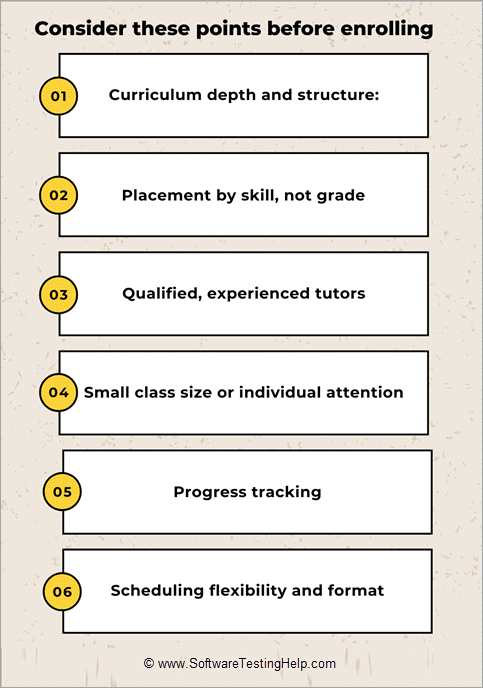
Points to Consider before Enrolling:
- Curriculum Depth and Structure: Look for programs beyond memorization to teach core concepts, problem-solving, and critical thinking. A continuous K-12 pathway can help build fluency year after year.
- Placement by skill, not grade: Pre-enrollment assessments help match students to the right difficulty level, providing enough challenge to promote growth without causing frustration. This tailored approach supports individual potential over group-based expectations.
- Qualified, Experienced Tutors: Instructors should specialize in instruction, not just general tutoring. Look for programs that prioritize teaching expertise and consistency.
- Small Class Size or Individual Attention: Whether in a group or one-on-one format, students should receive personalized support and have time to ask questions.
- Progress Tracking: A strong program will regularly assess and report on student growth, helping parents understand outcomes and areas for improvement.
- Scheduling Flexibility and Format: Online or in-person options allow families to choose what works best. Some also offer accelerated, honors, or summer programs.
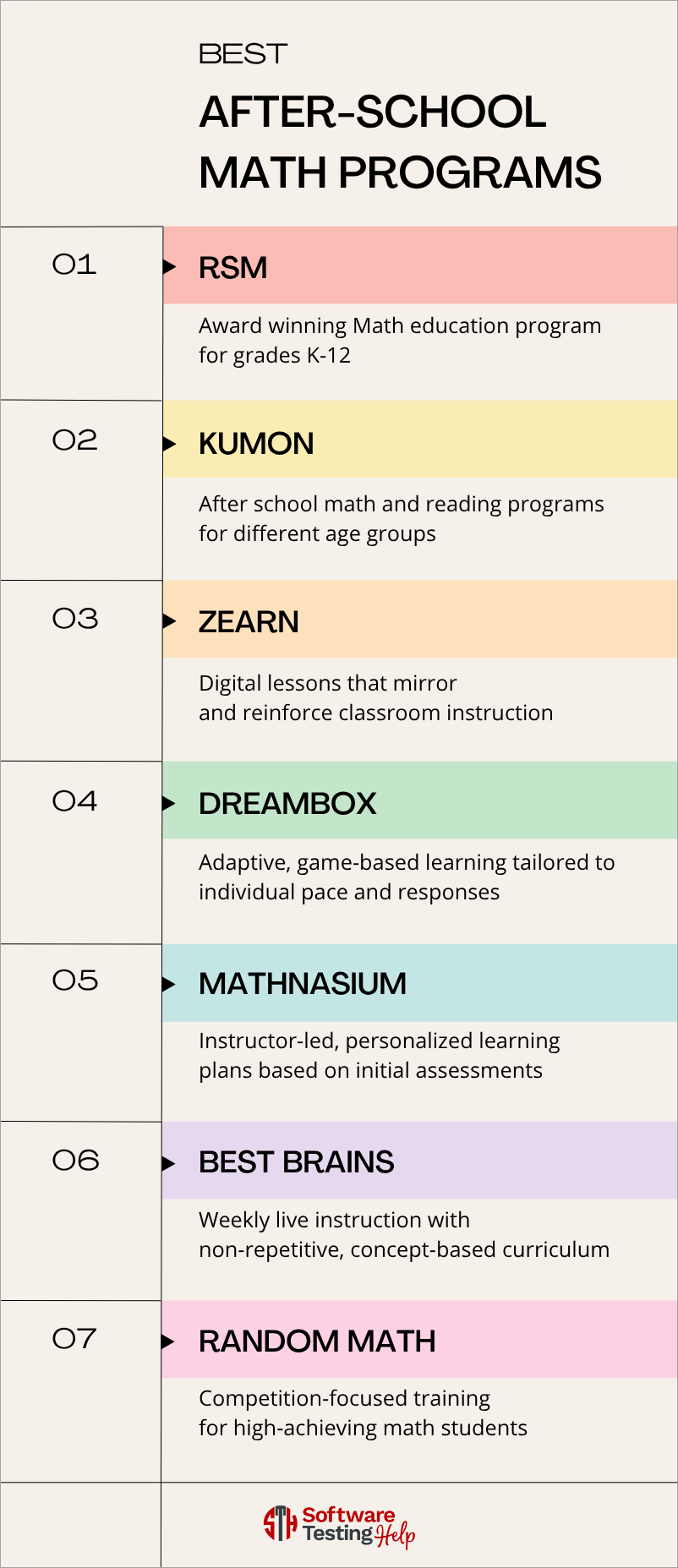
7 Best After-School Math Programs
- RSM
- Kumon
- Zearn
- DreamBox
- Mathnasium
- Best Brains
- Random Math
Comparing the Top Math Programs After-School for Future Excellence
| Program | Core Approach | Standout Features |
|---|---|---|
| RSM | Structured classroom-based learning focused on conceptual depth and long-term math fluency | • Continuous K–12 curriculum • Three levels per grade • Strong competition prep • In-person and online options |
| Kumon | Self-learning through daily worksheets and incremental mastery | • Short, daily practice • In-center and at-home model • Strong study habit development • Globally recognized |
| Zearn | Digital lessons that mirror and reinforce classroom instruction | • Free for teachers • Built-in support and scaffolding • Aligns with Eureka/IM • Adopted in multiple states |
| DreamBox | Adaptive, game-based learning tailored to individual pace and responses | • Just-in-time personalization • Visual models and progress dashboard • Research-backed for K-8 |
| Mathnasium | Instructor-led, personalized learning plans based on initial assessments | • The Mathnasium Method™ • 1:1 and small-group instruction • Strong results in student confidence and grades |
| Best Brains | Weekly live instruction with non-repetitive, concept-based curriculum | • Certified educators • Daily practice at home • English, abacus and coding programs included |
| Random Math | Competition-focused training for high-achieving math students | • AMC, AIME and USAMO prep • Elite coaching staff • Multilevel placement • Rigorous two-class structure |
With so many after-school learning service providers on the market, it’s hard to know which is best for your child. These are the top contenders in math-based tutoring and learning programs. Each has unique offerings and approaches that match your child’s unique needs for continued success.
#1) RSM
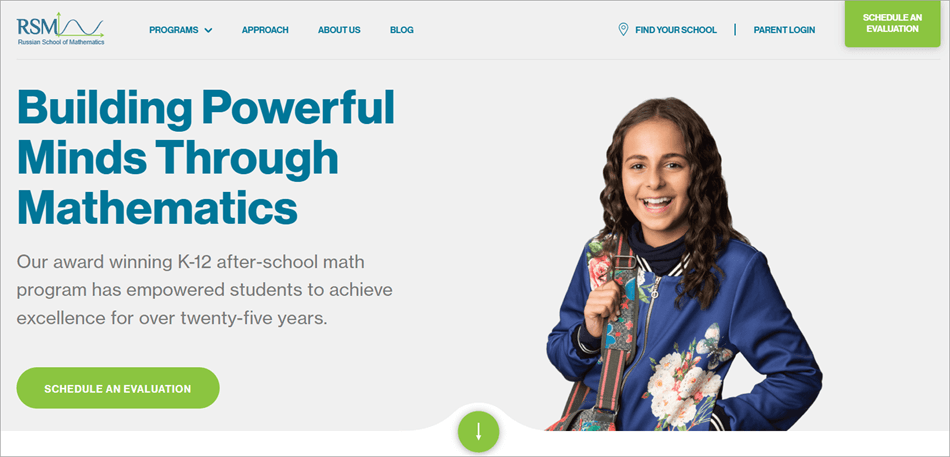
RSM is not a tutoring center. It’s a full-scale math school designed to develop confident, future-ready thinkers through the study of mathematics. It features a continuous K-12 curriculum and a deep-rooted focus on logic, reasoning, and conceptual understanding.
RSM’s model is inspired by the rigorous math programs used in elite Soviet schools and adapted for the American education system. The result is a structured, year-round program that supports students from elementary through high school, emphasizing early abstract thinking, competition preparation, and long-term academic growth.
Unlike one-size-fits-all tutoring, RSM places each student in one of three levels per grade – accelerated, advanced, or honors, based on their current skills and readiness. These small classroom cohorts create an environment where children learn collaboratively and stay consistently challenged.
As learners progress, they sharpen their analytical abilities, debate problem-solving strategies, and gain exposure to advanced concepts, often years ahead of their peers in traditional schools.
RSM students regularly excel on standardized tests and math competitions, including the AMC 8-12 and Harvard-MIT Math Tournament.
RSM offers in-person and virtual classrooms, with more than 70 physical locations across the U.S. and Canada, plus a fully interactive online program. All instructors have strong math backgrounds and are trained in RSM’s specialized method.
With over 90,000 students enrolled and alumni accepted into top universities, RSM remains one of the most academically rigorous and results-driven after-school math programs available.
Why choose RSM:
- Structured progression with continuous K-12 curriculum design
- Placement-based learning with three levels per grade
- Teacher-led instruction
- Academic rigor for a good return on investment
- Competition success across all major math exams
- Remote and in-class access across 70 locations
- Family-owned locations, driven by excellence, not franchising.
#2) Kumon
Kumon is one of the world’s most widely recognized after-school math programs, with more than 2,200 centers in the U.S. and a presence in over 50 countries. Founded in Japan in 1958, the method was born from a father’s desire to help his son succeed in school.
What began as a few worksheets at a kitchen table evolved into a globally adopted system of self-learning, incremental progress, and daily practice.
Suggested Reading => 70+ Best Udemy Courses
Kumon math is designed for students aged 3 through high school, covering everything from counting and number sequencing to calculus and statistics. Rather than relying on direct instruction and tutoring, Kumon enrollees complete daily worksheets – about 30 minutes per subject – focused on mastering one skill at a time before moving on.
They attend in-person or virtual sessions twice a week, where instructors observe their work, provide guidance, and adjust lesson pacing as needed. This model reinforces consistency, concentration, and self-discipline – essential skills for long-term academic success.
Each student begins with a placement test to determine their level and starts slightly below it to build confidence and fluency. The curriculum is carefully structured, so even advanced topics become approachable through exposure and repetition.
Kumon instructors are supportive, cultivating independence rather than just delivering step-by-step teaching. Kumon can be an effective long-term investment for families who value structure and measurable progress.
Why choose Kumon:
- Self-learning with independent problem-solving
- Study habits built through short, daily assignments
- Advancement is mastery-based; students move on only after fully grasping a concept
- Wide subject range, from basics to advanced calculus
- Global reputation, trusted by millions
- Flexible format with in-person and virtual instruction
- Instructor oversight with guided support
#3) Zearn
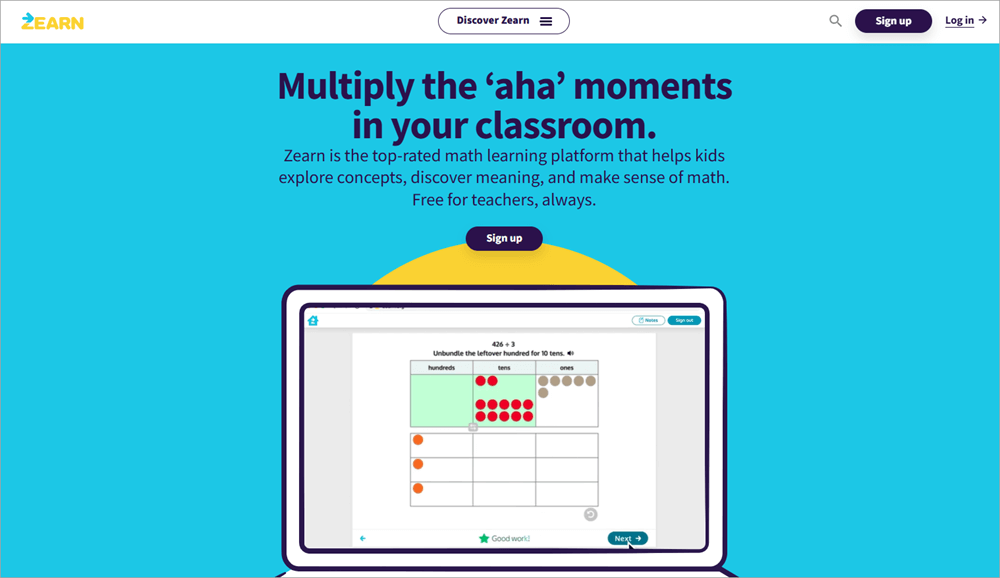
Zearn is a nonprofit math platform designed to reinforce classroom instruction through digital lessons built with and for teachers.
The program specifically targets elementary school students by reinforcing grade-level learning with visual models, on-screen teachers, interactive problems, and immediate feedback. The free option has limited functionality.
Recommended Reading => Best Websites for Elementary School Kids
Each lesson is divided into bite-sized components that include short videos, guided practice, and digital manipulatives. When students make mistakes, built-in scaffolding helps them recover in real time, encouraging productive struggle rather than frustration.
The personalized support enables learners to stay engaged and build confidence, which is vital for classroom and future business success.
Use Zearn as a full curriculum, a supplemental resource, or an intervention tool. Students work independently at their own pace while teachers monitor progress and use insights to tailor instruction. Consistent use accelerates learning and expands annual learn time.
Why choose Zearn:
- Free to teachers and classrooms for increased accessibility
- Core instruction reinforced through digital lessons
- Built-in scaffolding for real-time student support
- Flexible implementation with full curriculum or supplements
- Visual models designed for equity and accessibility
#4) DreamBox
DreamBox is an adaptive online math platform designed to help K-8 students build a deep understanding and confidence through personalized learning. Whether at home or school, DreamBox adapts in real time to how each child solves problems, not just whether they’re right or wrong.
The program adjusts pacing, content, and support to match pupils’ thinking, offering just-in-time scaffolding to help them persist through challenges. With over 2,000 lessons aligned to math standards, it is a flexible tool for intervention, enrichment, and daily practice.
Also Read => Online Typing Games for Kids
It develops a skill-building mindset. The game-based environment makes math approachable and engaging, especially for learners who struggle with traditional instruction. Built-in motivators like avatars, certificates, and progress dashboards keep students invested, while real-time reporting gives parents and teachers insight into what’s clicking and what isn’t.
An hour per week has shown measurable gains because the program constantly recalibrates, keeping students at the right challenge level. Sign up via school licenses or family subscriptions. The platform is popular among homeschooling parents who seek productive screen use.
Why choose DreamBox:
- Adaptive learning that responds to student thinking
- Standards-aligned K-8 curriculum
- Game-based motivation with avatars and rewards
- Flexible use at home or school
- Personalized pacing for skill development
- Research-backed outcomes of schooling systems
#5) Mathnasium
Mathnasium has over 1,000 locations across the U.S., and it’s designed for students in grades K-12. It blends personalized learning plans with in-person or online instruction to help children catch up, keep up, and get ahead in math.
The heart of the program is the Mathnasium Method™. This structured approach starts with a comprehensive assessment to identify skill gaps, then builds conceptual understanding step-by-step using mental, verbal, visual, tactile, and written techniques.
Enrollees typically attend two to three sessions weekly, either at a local center or online. Trained math instructors who teach for understanding, not just memorization or speed guide each learning plan.
Also Read => How to Teach Coding to Kids
Lessons are built around number sense, logical reasoning, and problem-solving skills, gradually moving toward advanced topics like algebra, geometry, and calculus. The program adapts to meet students’ changing needs and maintains their motivation.
Parents report reduced math anxiety, improved grades, and a dramatic shift in how their children learn. Students gain confidence and fluency with regular, goal-oriented sessions without the pressure of standard timelines. Enrollment follows a gym membership model, with flexible scheduling and consistent support.
Why choose Mathnasium:
- Structured Mathnasium Method™ model for deep understanding
- Personalized plans based on verbal and written assessments
- In-person and online instruction options
- No homework model to reduce pressure
- Tailored to struggling and advanced learners
#6) Best Brains
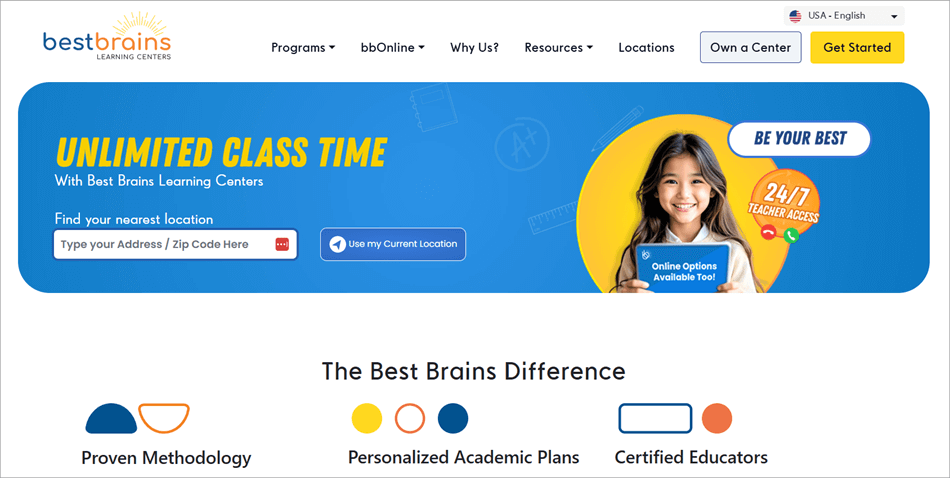
Best Brains offers a comprehensive after-school math program to help learners build confidence, master core concepts, and think critically, not just memorize facts. The curriculum uses a non-repetitive, concept-based teaching model to focus on logic and problem-solving.
Rather than drilling students with worksheets, Best Brains emphasizes comprehension, real-world application, and incremental progress, creating a deeper, more lasting understanding.
The program begins with a free placement test and weekly one-on-one instruction from certified teachers in person or online. Every child receives a personalized academic plan tailored to their strengths and learning style.
Suggested Read => Best Tablet for Kids
Teachers provide direct instruction during weekly sessions, while students complete daily structured practice. Best Brains shares regular feedback with parents to keep all stakeholders involved in the learning journey.
The curriculum includes everything from number sense and computational algebra to geometry and data analysis, making it ideally suited to developing the future’s business leaders.
It’s suited to all levels of learners, and the unique teacher-led model with small groups makes it an ideal alternative to digital-only learning. The flexible month-to-month enrollment makes it easy to sign up, though most learners stay with the system long term because of the benefits.
Why choose Best Brains:
- Concept-based instruction that builds reasoning without rote memorization
- Weekly live instruction by certified educators
- Personalized academic plans tailored to each learner
- Full curriculum coverage from basics to advanced topics
- In-person and virtual format options
- Regular parent feedback and progress updates
- Month-to-month enrollment with no contracts
- Strong outcomes reported by families
#7) Random Math
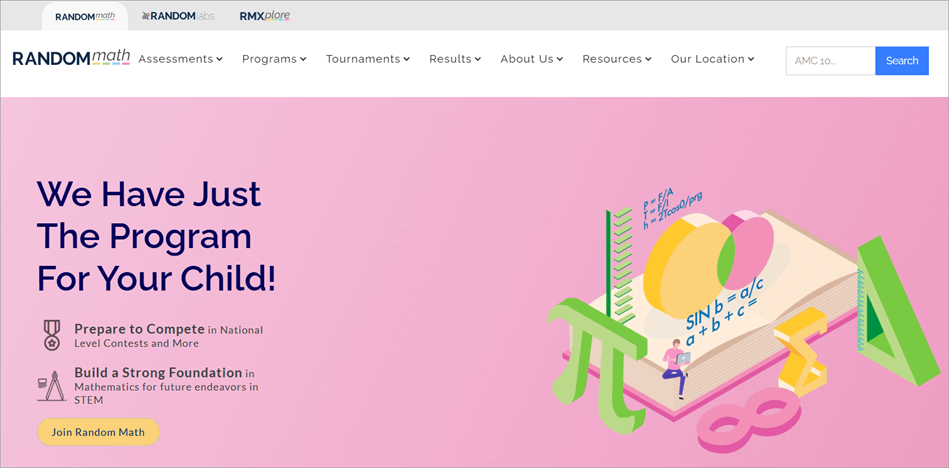
Random Math is an elite after-school math program designed for high-achieving learners who want to compete at the highest levels of national math contests. The company is based in Cupertino, California, and online options are available.
It trains students from grades 3-12 for competitions, including the AMC8/10/12, American Invitation Mathematics Exam (AIME), Harvard-MIT Mathematics Tournament, Berkeley Math Tournament, and United States of America Mathematical Olympiad (USAMO).
With over 125 AIME and 21 USAMO qualifiers, the program has a strong track record of helping students achieve national recognition in competitive mathematics.
Random Math features a rigorous assessment and placement process. Students are evaluated and grouped by skill level rather than grade, ensuring that instruction is targeted and appropriately challenging.
Once placed, they attend two weekly sessions – a two-hour instructional and two-hour practice session – focused on deep problem-solving across algebra, geometry, number theory, and combinatorics.
Random Math also offers accelerator programs, summer intensives, and a “Together” program that trains students in team-based problem solving and contest collaboration. Instruction is delivered by a highly credentialed coaching team that includes Olympiad alumni, Stanford and MIT graduates, and experienced math educators.
Classes are capped by quality, and every student receives personalized coaching and consistent feedback. The focus is not on remediation but on pushing boundaries – ideal for children already performing at or above grade level.
Why choose Random Math:
- Competition-focused for top-tier math contests
- Seasoned instruction from Olympiad-level faculty
- Skill-based student placement, not age-based
- Twice-weekly sessions with optional accelerators and camps
- Collaborative “Together” program for team training
- Dozens of AIME, USAMO, and other contest qualifiers yearly
- Online and in-person nationwide access
FAQs on Math Tutoring Programs After-School
1. What’s the difference between a Math Tutor and an After-School Math Program?
Tutors typically offer one-on-one help with specific topics or assignments. After-school math programs provide structured, long-term learning through a full curriculum.
These systems often focus on building core understanding, problem-solving abilities, and math fluency over time.
2. Will an After-School Math Program help with my child’s school performance?
Many students see improved grades as a result of reinforcing foundational skills and developing confidence in math. While not always focused on homework help, strong programs deepen conceptual understanding, which can lead to better school performance and on standardized tests.
3. How are students placed in these programs?
Reputable math programs assess students before enrollment and group them by skill level rather than age or grade. This ensures they are supported, sufficiently challenged, and can progress at the right pace, not simply being dragged along at their peers’ level.
4. Is online Math Tutoring as effective as In-Person lessons?
Tutoring is excellent when designed with intention. High-quality online programs use live instruction, interactive classrooms, and expert teachers to replicate the benefits of in-person learning. They also offer flexibility for families with busy schedules or limited access to local centers.
5. How much time do students typically spend in a Math Program each week?
The length of sessions depends on the enrollee’s age and level. Most high school students attend classes twice weekly for 60-120 minutes per session. Some systems include optional homework, test prep, or summer courses to reinforce learning and offer additional support.
Final Thoughts on After-School Systems Bring Math Success
These extra-curricular programs can unlock a child’s full potential by building deep understanding, confidence, and critical thinking skills.
Whether you’re looking for enrichment, support, or long-term academic growth, the right system offers structured learning beyond tutoring. With expert instruction and a proven curriculum, math can become a lifelong strength and a pathway to future success.
Was this helpful?
Recommended Reading
-

List of the Best FREE Online Courses With Ratings, Skills, Course Provider and Enrollment Link. Select an Online Certification Course Based on Your Interest: In today's world, nothing comes for free. Whether it is Medical, Education, Automobiles, Software, or Textiles, everyone is runnings their business only with a profit motive.…
-

Start your career in Cybersecurity with this list of the best online Cyber Security Training Courses. Pick the right cyber security course that is affordable in your budget: Cybersecurity certification courses are readily available online. While we have free cyber security courses, we also have those that come with monthly…
-
Gain expertise in talent management, employee relations, and recruitment strategies with these top HR courses online. Pick the perfect course to learn the intricacies of human resources and enhance your career: A Human Resources manager is the one responsible for the management of the workforce of a business enterprise. He…
-
This is a step-wise guide to help you understand how to create an Online Course. Also see some useful tips to promote your course: The advancement of communication and internet technologies has allowed innovative delivery of information and education. The restrictions due to the COVID-19 pandemic have accelerated the growth…


