


Steps to write a perfect QA resume with a sample QA Software Testing resume and template download:
A commonly asked question, mostly by newcomers into IT, is “Do you have a sample Software Testing resume that I can use?”
Sure, we all learn by seeing. To begin with, we need to establish a point of reference, so there is no harm in checking out someone else’s resume. However, relying completely on it and trying to tailor it to suit our needs is not always the best way to create our own resume.

Read How to Write a Killer Software Testing QA Resume as the first part of the QA Resume guide.
How would it be if I took a picture of a perfect looking person and photoshopped my face onto it – it just would not be right, would it? The same rationale applies here.
Each of us comes from different educational backgrounds, different professional exposure and are at different proficiency levels – our resume has to be a snapshot of everything that is uniquely us. The piece of paper (or electronic document) is a representation of ourselves when we could not be there in person.
Therefore, it is of utmost importance to let your resume capture the essence of who you are as a professional. In this article, I have tried to put together a few simple pointers that will help ease this Software Testing QA resume preparation process, especially for first-timers.
Table of Contents:
How To Start Writing a Software Testing Resume?
To start with, these are some of the pre-activities called as resume preparation:
#1) Try to make a list of all your skills, education, work experience, platforms, technologies, projects, etc.
#2) For a start, forget about the format and template. Sticky notes, a piece of paper, a notepad on your computer – all are perfectly good starting points.
#3) The list could look something like this:

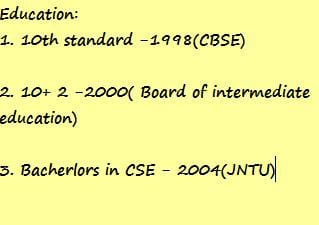
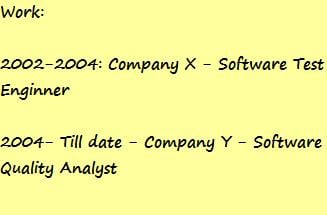
#4) Pick up the technical skills section and try to sort them in the order of your proficiency. I generally use the rating method on my skills. On a scale of 1-5, 5 being the expert and 1 being just familiar- try to assign a rating to your list
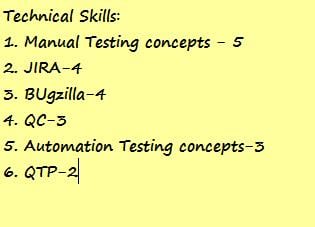
#5) Take a moment to review your readiness with respect to the skill acquisition required to apply for the job of your choice.
From the above list, it is clear that I am not at the required skill level to apply for a QTP position. That is ok. To enhance our strengths we always need to know our weaknesses. This method helps us with that. There are 2 options at this stage:
- If QTP is not my area of interest, I just move on and apply for a Manual Testing job that better suits my skill.
- But if I want to pursue Automation Testing, I can take a few days’ time and work on building the skill. Once I move to anywhere between 3-5 rating level, I may reconsider a QTP career.
Once listing, rating and self-evaluating is through, the next step is to think of a template.
Software Testing Resume Sample Template Download
Every IT resume has the following sections. Of course, the order in which these sections appear is a personal choice. As for me, I find the below order very effective, so stick to it if you think so too.
#1) The Header: Basic information about how to reach you – Name, Address, Email ID, Phone number, link to your profile on a professional network, certifications, etc.
#2) Objective: Optional section, especially useful to explain your choice of getting into IT- QA field if you have not been from a computer science background and have a different career prior to now, or if you have been from a certain branch of IT and want to transition to another one.
#3) Professional Summary: A gist of your skills, your strengths, roles performed, technologies you know, achievements & awards, certifications if any, etc. Start with the points that are most significant in the list.
#4) Certifications: Include this section if you have been certified in many areas. Note: I have come across some newcomers who include – “preparing for ISTQB” or something to that effect in this section. This is generally not apt. Include only the ones that you have already been certified. For multiple certifications use a table.
Also read =>> How and where to put certifications on your resume.
#5) Work experience: List all the organizations you have worked for until now. A table works best for this. Order the columns in this table by keeping your most recent experience as the first row.
#6) Technical Skills: List all your skills acquired on-job and off-job according to categories.
#7) Educational Information: Tabular format works best for this too. Start with your highest education as the first row. Provide the P.G/ graduation/10+2/10 standard, year of passing, institution/city you went to next. It is optional to include the score you received.
#8) Projects: Projects are the main section in itself. This is where specific information about the kind of work you have performed during the course of your previous employment leading up to now. If you have multiple projects, start with your most recent project and move on to the next.
For each Project include:
- Project Header:
Project Name
Client: (optional and wherever relevant)
Duration: Start Month/Year – End Month/Year
Role:
Environment:
Tools:
- Project Description: (A short paragraph about the application that was worked on. Detailed functionality is not necessary)
- Roles and Responsibilities: Use bulleted points to describe what your day-to-day activities on the job were.
- References: Provide names and contact information of your previous managers and/or colleagues whose feedback can be sought. Alternately, you can choose to provide it on request by saying “References will be provided on request”.
Now that we have the information gathered during the pre-resume step and the template, all it takes is to organize the information into a template. Use the template attached for more clarity.
=>> QA Software Tester Resume Sample – Download Sample Template

This software testing CV template can be used by experienced as well as beginner-level professionals. All the sections are given here. All you need to do is fill in your information. Here are samples of how to define roles and responsibilities, professional summary, project description, etc. are provided too.
Sample of Shorter Software QA Resume
There are 3 main trends that are gaining momentum.
#1) Shorter 1 or 2 page resumes
#2) Skype or video-based interviews
#3) Presentation based interviews
A few tips to add to the above article are:
- Take complete control over your resume: Don’t let a resume creation company, family member or a friend take this over for you.
- No mistakes: Spelling, grammar, hyphenation, margins, alignment, etc.
- No False Information: This is where I am going to hear all of you sigh and say “how is that even possible”- but trust me. When you create a resume that focuses on your skills and strengths, there is really no need for any false information to be included.
- No confidential information about your previous clients, companies or projects
The current job market is really leaning towards shorter resumes over the full versions. 1 or 2 page resumes even for the most experienced ones are preferred.
Include the following information in your resume:
- Header
- Objective (optional)
- Professional Summary
- Qualification/certifications/achievements
- Consolidation of your technical skills
- Projects
Take a Look at the Shorter QA Resume Sample
Name
Title (For Example, Quality Engineer/QA Tester/Manager)
Certifications: (if any)
Contact info: phone, email, address
LinkedIn or other website/blog link (if any)
Objective: To excel in a challenging and innovative QA work environment and strive to exercise my full potential (OR) to make a smooth and successful transition into IT- QA post my thorough preparation and internship (OR) (something to that effect. This can be totally optional as well).
Professional Summary: (This is not very different from the traditional resume – some examples can be as below).
- Well versed with SDLC – Agile and Scrum methodologies.
- Underwent 100 hours of professional training in the Software testing process.
- ISTQB or some other certification.
- Good understanding of the STLC process – Test case documentation and review.
- Familiarizing with Automation Testing using QTP
- Involved in testing during system testing or UAT phases.
- Expertise in Test Management using QC or JIRA
- Defect management using Bugzilla
Certification/Qualifications/Achievements:
Examples include:
- Certified Software Test Engineer by QAI in the year 2014.
- Received the “Pat on the back” excellence award for my contribution towards “XYZ” project.
- B.Tech Computer Science Engineer by Education, 2010 Graduation Year.
- Implemented a new framework in QTP.
Skills:
Examples include:
Tools: HP UFT, HP ALM – Administration and User, VersionOne-Agile Management software, Atlassian JIRA
Environments: UNIX, Windows, Mac, Mobile – IOS
Programming languages: Java, VBScript
SQL and PL/SQL
Projects:
This is where this kind of resume differs largely from the existing type. Here is my take on whether the subject – project description part can be eliminated.
In fact, companies prefer it that way, because it shows integrity to not talk about how other clients have implemented a certain system and to instead on your tasks and work highlights. As always, start with your most recent project and keep going backward.
#1) OpenEMR, hospital management system for XYZ hospitals – Nov 2013 to Dec 2014 – Quality Engineer
This is a 3 tiered system and we have successfully implemented an end to end testing system that pays special emphasis on the release of targeted testing and ample regression as well.
The team structure is onsite-offshore and agile processes are managed by leveraging VersionOne as the management software.
Important Points in Resume Creation Process
To summarize, these are the steps in the Resume Creation process:
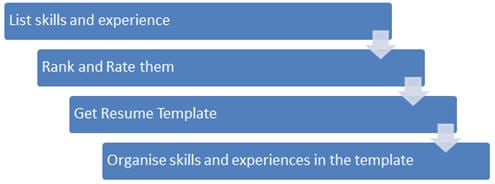
Few Important Do’s and Don’ts:
#1) Try not to create a huge resume. 3-4 pages are optimum for a beginner level professional. For experienced personnel, try not to run over 5 pages.
#2) Do not include personal information like – passport numbers.
#3) You can include information regarding your marital status, date of birth, etc., but it is not necessary.
#4) MS Word or PDF is the standard format for a resume.
#5) If you are a newcomer and have no prior employment, you can still include project information. These projects are going to be off-job, self-initiated. For example, pick gmail.com or amazon.com and test it thoroughly, following a testing process that is as close to a real-time project as possible. Document your results and include that as part of your experience.
#6) If you are from a non-IT background and want to include that experience, keep it to a minimum.
#7) Resumes are now being picked up by search engines. So include as many keywords as possible and include them repetitively.
However, use them with caution. I have come across many resumes that include every skill available in the market. A resume is your entry ticket into a job interview, not into a job. Including skills that you are not good at will put you in a compromising situation when you can’t explain them in an interview.
#8) Do not circulate your resume flippantly. Do not post/circulate your resume just to get a feel of the market or to understand how much pay you might receive. Do it only when you are ready for an interview. You do not want to miss a chance at landing a job due to unpreparedness. Be prepared to attend an interview from the minute your resume is out there.
#9) Avoid writing huge paragraphs. Stick to bullet points.
#10) Check for spelling and grammatical errors.
#11) Once you are complete, save your doc with an appropriate name. Typically, “Name_Role/tile_years of experience.doc- (Name-QA Analyst-8 Years.doc)” is recommended.
Now, the resume making process does not seem so daunting, does it? Let us know what tips and guidelines you find most useful.
Was this helpful?
Recommended Reading
-

n recent days this is the most asked question to me by readers. How to get software testing job? How to come in software testing field? or Can I get job in testing? Here find it how.
-
Software Testing Course Syllabus and Training Plan Week 1 Brief introduction to software systems and SDLC Basic concepts Basic Testing Vocabulary Quality Assurance versus Quality Control The Cost of Quality Software Quality Factors How Quality is Defined Why Do We Test Software? What is a Defect? The Multiple Roles of…
-

This knowledge quiz is an attempt to test your Software Testing basic knowledge with a simple 20-question test. The following Software Testing quiz is designed to test your ability to meet Software Testing requirements. This Software Testing quiz will help you with self-assessment and prepare for other certification exams, as…
-
I am happy to share the "Manual Testing Help" eBook prepared by one of our readers. The content of this eBook is very useful to understand manual testing concepts, testing methodologies and preparing for Software Testing interviews. Here are some of the topics covered in this book: Fundamentals of software…


I have completed BE IT and now working in Non IT sector, I completed certification in software testing.My question is how I mention my experience in CV.
Please assist
Thanks,
Preet
After submitting my email address for ebook, i did not receive any further instructions as mentioned here.
Thanks a lot was looking for tips to make a resume got what I needed.
Hi sir,
I done one project on EBanking,
please send me 1yr experiance Resume
Sir, I worked as s software tester for three years from 2006-2009 but after that i have got a break of four years due to some restrictions of my visa. now its all ok with the visa and whats the best way to get back to testing career again. Pls help me.
Rob..
Thanks a lot for this article. It is very useful to all the testing engineers.Keep on posting such articles.
@jyothi: This article is to get you started on creating your own resume in your own unique way. Instead of looking for a 1 year old experience resume, why dont you try following the steps here and try to write it. It is easier than you would think. Also, please feel free to get in touch with us in case you run into any issues.
Thanks for this valuable info!
I am loking for Testing 3 yrs experince resume
plz send me the profilr for experience
wow thanks vijay and swati this one is perfect…. The idea to save the resume as “Name_Role/tile_years of experience.doc is really great… thank you
thanks sir ,I have 3.9 years exp currently im not working i have 1 year gap any solution
hi,
i am looking for best testing profile for fresher.
please provide me.
Thanks a lot. I am fresher in testing and was looking for a template. 🙂
Hi,
I am regular reader of software testing help articles. currently i am working in Telecom Domain with no any knowledge of testing from last 5 years.
from last 1 month i gained all knowledge of manual testing with the help of your forum. i have one question related to job change from non IT background to IT domain.
what you suggest me in writing my resume to switch job from telecom to IT.
Thank you for your work!
It is a perfect document for resumes
Thanks for sharing Vijay. Well, I do not agree about mentioning projects in the CV. Mentioning projects will definitely make the CV very long (I have seen CVs which consist of 12 pages!!!). Rather, I would recommend to mention the skills you gained from the projects and to leave the projects to the interview itself.
Thank you for the template. it is very useful.
nice article with detailed information.
Hi Vijay
Thanks for this useful info.
hi vijay,
Thanks for this article. its so helpful for us..
but i have question. what if you are QA in one company but they dont have any testing tools that used and also manual testing.. just test and test the software until done and ok to implement..
thanks,
i hope you understand my question
thanks @swati for such a good reply of @Mica,query , that how to write good Resume if u don,t have knowledge of many tools .
Thanks for the sample, it helped me a lot and keep up the good work
@karuvarasan: Glad that you found the naming convention tip useful. You are one of our most valued readers and we do appreciate your readership. Thank you
hello vijay
my problem is explaining a project to a interviewer?
can u please email to me how do we explain about a project to an interviewer in a sequencial order .
can u please email me with a real time project how to explain.
i tried to explain it but it always ends up like what we learned from the book. i am not bale to explain theproject with real time experience.
please do help me. thanks
A very helpful post… Thank you
I am loking for Testing 3 yrs experince resume
Very nice template
INFORMATIVE POST..THANKS
? Testing Tools: Enterprise Testing Tool, Cucumber
? Bug reporting Tool: JIRA
? Software QA: SDLC, STLC, Bug Lifecycle, Agile Methodologies
? Operating Systems: Windows, and UNIX
? Documentation: MS Office, Open Office
? Database: SQL
? Programming: Java (Basic)
This article is really useful for preparing effective resume. Thank you vijay.
Hi! I was badly looking for a project to fill my resume . Thank you so much for your valuable information.
Hi..i seen your tips and sample resume..really good very use full..can u provide me performance testing resume on 3+ just sample please
bhaskar.nb234@gmail.com
Really very useful….. Thanks a lot.
Hi Swati, I have 6+ years of experience, 3 in manual, automation and 3.2 Years as an Network planning engineer.
now I am a QA engineer.
Could you pls help me on how to mention all these in resume.
@Rob: Glad to hear that your legal status permits you to get back to work. I think, the first step is to evaluate your readiness. Take a look at QA job postings(for your relevant experience and skills) and make an assessment about where you stand. If you feel its necessary, take some time to brush up your skills(if needed, consider taking an online class). Remember, you might be rustic at the beginning, but we rarely unlearn what we learned. It might just take a little bit of time to come back to you is all, so please be patient with yourself.
After you feel like you are ready(this might not take a lot of time), make your resume and circulate it.
We all do not live in a perfect world, so pauses in professional life are normal. Do not think of it as a set back. Be confident.
Wish you the best! Please feel free to reach out to us for any further help.
Many thanks for this useful article 🙂
Hi Swati, I have 6+ years of experience in manual, automation and IOT application testing.
I started my carrier as software test engineer and now I am a senior QA engineer.
Could you pls help me on how to mention all these in resume.
@SWATI – Excellent reply to ROB. It helped me as I am in the same boat. 🙂
Hi,Really thanks to you.Whatever points you suggested to improve the resumeis really impressive and rocking.It will definately help the jobseekers like me to get the job as resume is like mirror of the employee.Thanks again
@Anwar: Sure, when there are lots of projects and a few considerable number of years of experience, the project information might make the resume bulky.
We are trying to give out the most basic template that is fit for the majority of our readership. Hence, the generalization.
Thanks for letting us know your opinion. We do appreciate it a lot.
@mica: I do understand you situation. For a manual testing project without usage of tools, you would like to know how to make it more fetching for you. Is that right?
Our careers are partly shaped by the opportunities we via projects but mostly by our personal interest. If tools are what you would want to focus on try to create a resume in a way that emphasizes more on skills than experience.
The first step would be to learn the tools of your choice.
The next would be to incorporate your learning experience into your resume as a skill you have acquired as opposed to be it being a tool experience.
An example: 2 years experience using JIRA- focus is on experience here.
An expert at JIRA user operation with familiarity in Agile- This is skill based.
This could have a positive impact on your resume.
I hope this helps!