


This tutorial explains Interactive Application Security Testing (IAST), a web application security tool to detect security vulnerabilities:
IAST (Interactive Application Security Testing) is a security tool that combines the security function of Static Application Security Testing (SAST) and Dynamic Application Security Testing (DAST) into one security tool.
It is an application security tool that was designed and developed for both web and mobile applications to detect and report issues even while the application is currently running. Before you can comprehend the understanding of Interactive Application Security Testing fully, you must know what SAST and DAST mean.
IAST is still relatively new in town and focuses on the detection of security issues in the code of your applications. It runs directly in the application server as an agent. It serves as real-time detection of application vulnerabilities by just analyzing all traffic within the application and the execution flow of the application. Just browsing the applications will capture all the security flaws in the application.
What Is IAST
While test browsing the application, the result can be reported in real-time via a dedicated reporting system and the result can also be integrated with other issue tracking tools that help team collaboration.
IAST Security Role In DevOps
Research over the years on Data Breach shows that most of the attacks were on web applications and the number is still on the high.
Recommended Reading =>> Compare SAST, DAST, IAST, And RASP
Web applications have attack surfaces that attackers usually use to get access to unauthorized and sensitive data like passwords, and financial and health records.
This gives more reason that every organization should ensure their web applications are properly secured before rolling them out to production for public consumption which could result in a data breach and can cost the organization financial loss because of a legal suit or otherwise.
While SAST solutions usually identify vulnerabilities in static code and when development is still in the development stage before build.
IAST, on the other hand, identifies security vulnerabilities in real time when the application is running and provides the developers with important information about where the issue can be found and how it can be remediated quickly before the application goes to production so that data breaches can be avoided.

[image source]
Interactive Application Security Testing has:
- Web APIs that you can integrate into your DevOps for proper testing and other enterprise tools.
- Can integrate with Jira which can serve as a collaborative tool for your DevOps. Its purpose is for bug tracking and other collaborative efforts that serve both the development and QA teams.
- Ability to work with other automated testing processes.
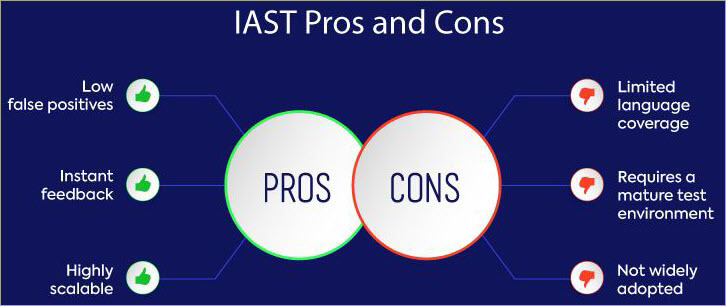
- Low false-positive output after the real-time analysis of the application.
- Ability to scale up in any enterprise domain.
- Different deployment methods can be both automated and manual methods and it also supports docker technology.
- Technology that supports cloud processes and also standard application architecture.

[Image source]
IAST Work Compared To Other Security Tools
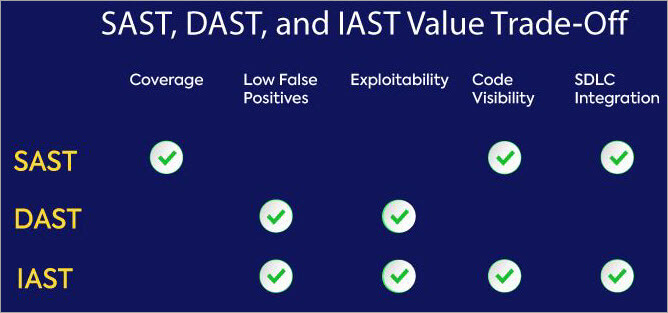
As earlier said, Interactive Application Security Testing is a combination of application security features from SAST and DAST.
IAST vs SAST
| IAST | SAST |
|---|---|
| It works in a runtime environment in the later stage of SDLC | Examine source code in a non-runtime environment early in the SDLC |
| It does not need access to source code | Requires access to source code |
| It analyzes all traffic within the application and execution flow of the application | They look for suspicious code patterns |
| It has low false positives reporting | Throws too many false positives |
| Fully engrossed during runtime and identify vulnerability | It cannot identify vulnerabilities during runtime |
| Runs inside the webserver | Run inside the IDE |
| Easy to deploy | Easy to deploy |
| Its language dependent | Its language dependent |
[image source]
IAST vs DAST
| IAST | DAST |
|---|---|
| It has visibility of the internal activities. | It does not have access to the source code. It is more of the exterior. |
| Does not need much interference from people. | It must be operated by an experienced security expert, usually used by penetration testers |
| IAST is a real-time (zero minutes) | DAST scan that can take days |
| It is more of a white-box tool | It’s a black-box tool |
| Its language dependent and work best when used on same language platform | Its language independent and can test any application environment |
Also Read =>> Application Security Testing tools
Examples Of IAST Use Cases
IAST is a security tool that is very useful during all phases of the SDLC. We are going to consider three use cases during the software development life cycle.
IAST involvement in the development stage
The development team benefits a lot from IAST because of the way it helps to detect vulnerabilities in an application and this is usually done very early towards the end of the SDLC and not when the application has been deployed to production.
This reduces the remediation costs for the vulnerabilities. Please note that it can both work in pre-production and production environments. It is a security tool that fully supports CI-CD in the DevOps environment.
IAST involvement in the QA stage
It does not need to wait for any scan to be completed before reporting vulnerabilities in an application. It is a tool that can be incorporated into the quality assurance environment and CI-CD, it can be used for testing at the pre-deployment stage and is DevOps-friendly.
IAST is the production stages
It also provides the operations team with all the necessary support needed during the production stages. This is because not all vulnerabilities would be fixed before deployment to production.
So with this tool, you are assured of the application security even while in the production environment and it supplies you information on patches to prioritize to fix very serious issues and helps monitor the stability of the entire system.

Implement Interactive Application Security Testing
Let us understand the implementation below:
#1) Deployment into DevOps. For you to get the full benefit of IAST in your development environment, you need to integrate it into your CI/CD pipeline.
#2) Code review tool. Interactive Application Security Testing can be implemented to perform code reviews of applications written in the programming languages of your choice and can be compatible with the framework used for the design and development of the application.
#3) Integration into your collaboration tool. It is a great tool you can use with other enterprise solutions like Jira which is a collaboration tool that is very efficient in bug tracking and managing your development project.
#4) Easy customization to your choice. IAST is highly customizable to the needs of any organization. It’s a security tool that can adapt to your build environment with dashboards that you can use to track scan results.
#5) Prioritize Scan. The tool can be implemented in such a way that it attends to applications with high risk first.
#6) Scan Report Analysis. This application can be implemented to track and help in remediating issues quickly in the early stages of SDLC and not waiting till the end of the cycle. It removes every false positive from the report.
#7) Effective Training. Set up to train the security and development team on how to put the result of the scan to proper use in preparing for the deployment process.
What Benefits IAST Offer Your Agile Environment
These are enlisted below:
#1) Shift-Testing Left: Interactive Application Security Testing plays a fantastic role in shift-testing left very early in the software development life cycle. It shifts testing to the early part of the SDLC by detecting issues very early in the development stages and reduces remediation costs and development delays.
Any delays are cut to the minimum as this security tool helps to fast-track the time between the issue-reporting and remediation period.
Both the Security and development teams need SAST and SCA tools that are used during the development stage while IAST is a security tool that is used during the testing stage. Whenever there are some security issues found with IAST, this will be reported back to the developers who will fix the vulnerabilities during the development stage.
#2) Source of vulnerabilities Exposure: It is an excellent tool that analyzes the application inside simply because of its access to the application data flow, libraries, frameworks, and, source code. The ability to analyze the internal structure of the application helps developers quickly identify vulnerabilities and provide quick fixes.
#3) Accuracy: One of the key features is the ability to detect verifiable and possible security issues with a very low false-negative rate and non-verifiable security issues with a very low false-positive rate. It is quite better than SAST and DAST in throwing false alarms for issues found while both DAST and SAST too cannot match it on the level of amount of vulnerabilities detected.
The demand for functional applications is great, and every organization wants a security tool that will provide them with accurate reporting in terms of all the internal processes going on in the application and not a security tool that gives false reporting.
While it is not difficult for DAST to return high false positives but difficult for it to specify lines of code associated with the vulnerabilities. The IAST and SAST on the other hand can provide detailed information like the line of code with vulnerabilities to help both the security and development team.
#4) Valuable during all SDLC Phases: This is one security tool that is useful all through the software development stages. It does not just focus on a particular stage, for instance, it’s a tool that helps the developer fix issues in real-time during development and at the same time.
It’s a tool that is very important during the QA/testing stage. IAST also helps to detect vulnerabilities during production and the result is sent back to the development team for fixing.
#5) Seamless Integration with DevOps tools: This is a security tool that can fit into your DevOps and can also be integrated into other tools used in development and testing. DevOps teams need security tools that integrate seamlessly with build and QA/Testing tools that are very easy to configure and implement.
IAST is very easy to deploy and can scale up to any level of support to an organization and easily integrate into the CI/CD pipeline.
#6) Fast and Smart Feedback: It is a tool that provides real-time detection for vulnerabilities and immediate feedback. Once the code is run and scanned, the developer receives an immediate response and this guide on what to remediate.
This feedback is not only fast but clear and provides actionable points like the type of vulnerability and the line of code where the vulnerability can be found. This tool is what developers can implement into their secure coding practices because of the immediate feedback on what needs to be done.
The QA team too can benefit from the way IAST identifies security vulnerabilities for them with no prior experience as a security expert, the result is clear and explanatory. The security experts themselves benefit from this tool’s reliability by not wasting effort and time chasing after false positives and vulnerabilities.
#7) Static and Dynamic Capability: One important aspect is the static capability (ability to analyze static code) and dynamic capability (ability to analyze code in execution). This combination of capabilities brings out the best in IAST in the area of its high accuracy and tracing of the vulnerable area in the line of code and it makes fixing of vulnerabilities very easy.
#8) Language-Specific: The IAST application is installed into the same web server that the main application is deployed into and this makes it work best with the language it supports. It supports server-side architecture and modern application frameworks.
Even though Interactive Application Security Testing does not have enough coverage on every application when combined with other Application Security Testing (AST) tools, it performs optimally.
IAST In Software Development Lifecycle
The current trend in the agile environment is the replacement of DevOps with DevSecOps and this shows the importance of security in the development setting.
Whether active or passive, IAST is a tool well adaptable to any agile methodologies. It’s a tool that is needed by any business that builds their applications whether for their use or public consumption. The reason for this is that the tool will help any organization detect any potential problems very early to avoid the costs and risks of fixing security bugs in production.
Even though some security experts still consider IAST as complex when compared with SAST and DAST tools the effort is worth it as they are considered fit to be used as part of continuous integration.
Passive and Active IAST are both good for SDLC as the passive will only need more QA/tester interference and experience and can have more false-positive reports while the Active IAST is more thorough with testing and requires more computing power to achieve the desired result.
IAST requires a mature testing environment, a modern software development environment, and standard architecture for optimal performance.
Frequently Asked Questions
What is IAST security testing?
Interactive Application Security Testing is a tool that makes use of the static and dynamic process to help every organization identify vulnerabilities within their network that could cause a security risk to the organization and it helps to manage such issues through appropriate remediation.
Can IAST replace DAST or SAST?
It is a security tool that is still emerging and currently transforming the traditional way application security testing is performed. Even though this tool was not designed and developed to replace either the DAST or SAST tool, it’s more robust and superior to finding vulnerabilities in an application in the early part of the SDLC to avoid the high cost of fixing a vulnerability in production.
What is IAST?
It is a security tool used to analyze code for any security vulnerabilities within an application. The tool can be installed with the main application inside the web server and can be run either through an automated test or a human tester. The tool can be deployed both in the QA and development environment.
What is the difference between DAST and IAST?
Interactive Application Security Testing is all about the internal process of the application and runs inside the main application while Dynamic Application Security Testing runs outside the application and is usually done before or after go-live.
How is interactive application security testing IAST defined?
It is a software organization used today to analyze its critical applications in other to detect and remediate vulnerabilities.
What is IAST is DevSecOps?
It is one of the new security application testing tools that just emerged and it bridges the distance between SAST and DAST security tools that constitute the security line in DevOps.
Conclusion
Interactive Application Security Testing is an emerging technology that has been around for some years now and it’s still finding its footing in acceptance by the security and development community. The fact remains that each tool has its peculiar benefit and sometimes it may not be correct to approve one over the other.
We will keep saying that if you have the capital, why not go for SAST, DAST, and the IAST tools at the same time as these will guarantee you 99.9% if not 100% security vulnerabilities.
In the course of reading this write-up, you have seen some features of IAST that make it a tool that every organization needs to have at their disposal if they need to avoid any future risk of fixing vulnerabilities at a higher cost.
Was this helpful?
Recommended Reading
-

This tutorial reviews and compares the top Application Security Testing Software to help you select the best Application Security Testing tool to find security vulnerabilities: Application Security Testing Software is an application to find vulnerabilities in an application or your environment. Application Security Testing should be performed by looking at…
-
In-depth review of popular Dynamic Application Security Testing (DAST) Software with features, pricing, and comparison. Select the best DAST tool for your organization: There are two primary approaches for analyzing the security of web applications: Dynamic Application Security Testing (DAST), also known as black-box testing, and Static Application Security Testing…
-

Here is the list of the best mobile app security testing tools that are used for Android and iOS applications. These are tested and are free, open-source, static, dynamic, runtime, and MAST security testing tools available. Mobile applications manage sensitive information including personal information, credentials, and payments, and it is…
-
This is an In-Depth Review of how to perform web application security using AppTrana. Let's get started. With any kind of internet-facing site being prone to attacks, website security is no longer an option. Attackers do it for a number of reasons, some do it for fame, others do it…
-

Strategy for Mobile Application Security Testing: The mobile network has empowered the users to do almost all their business, financial, social operations etc., and hence almost all the companies have launched their own mobile applications. These apps are extremely efficient and they ease our day to day transactions. But there’s…
-
List and Comparison of the Best Cybersecurity Software to Protect Your Business from Cyber Threats: A Cybersecurity software is a must for the security and privacy of a business or individual. Cybersecurity is the method used to protect the network, system, or applications from cyber-attacks. It avoids unauthorized data access,…
-
List of Most Frequently Asked Security testing Interview Questions with detailed Answers: What is Security Testing? Security testing is a process intended to reveal flaws in the security mechanisms of an information system that protect data and maintain functionality as intended. Security testing is the most important type of testing…
-
How to make sure your web application is secure before release? Web site security testing is important part of software testing life cycle like other functionality and performance testing. This article will guide you with different type of attacks on web applications and information on how to perform security testing…


